Biology Student Resume Example

A biology student resume is read by lab managers who want to know which techniques you can perform unsupervised. Name the techniques, organisms, instruments and hours. Health programs read the same page for proof of hands-on work, and the degree alone says only that you passed the courses.

The Sample resume is a third-year biology major in Birmingham who teaches the introductory lab, processes specimens part-time at a clinical laboratory and spent a summer sampling streams at a field station. Those three entries cover the three paths a biology degree leads to: teaching and graduate school, the clinical laboratory, and field or environmental work. His page lists techniques as a skills block so a lab manager can scan it in seconds.

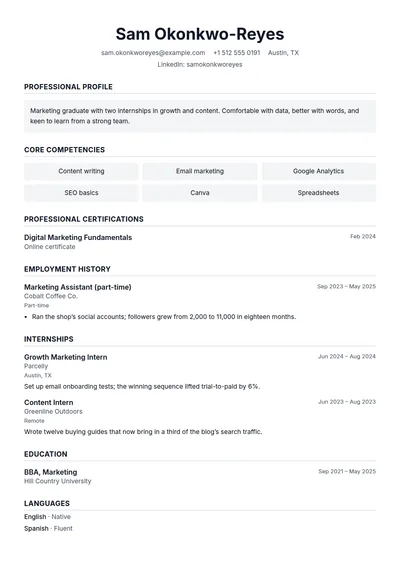
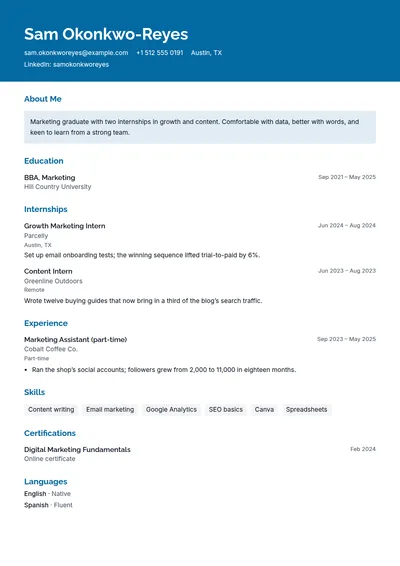
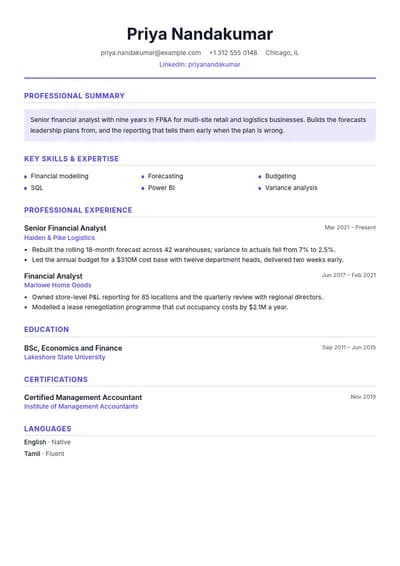
If you are heading toward medicine, the pre-med student example shows how clinical hours and shadowing are added to a science resume. Students pointed at a research career should also read the research assistant example. The Functional template suits a techniques-first page; the Campus template is the usual choice when experience is thin.

Updated . The person and employers in this Sample resume are fictional.

Biology Student sample resume

Marcus Adebayo

Biology Major, BS Expected May 2027 | Teaching Assistant and Laboratory Assistant

Birmingham, ALmarcus.adebayo@example.com(205) 555-0122

Summary

Third-year biology major at Red Mountain University (BS expected May 2027, GPA 3.6) with more than 500 hours of wet lab and field work. Teaches two sections of the introductory biology laboratory, processes about 150 clinical specimens per shift at a diagnostics laboratory, and completed a summer field technician position sampling macroinvertebrates across 18 stream sites. Comfortable with PCR, gel electrophoresis, aseptic culture and microscopy; seeking a summer research internship in microbiology or ecology before applying to master's programs.

Experience

Undergraduate Teaching Assistant, Introductory Biology Laboratory, Red Mountain University Department of Biological Sciences

– Present

Birmingham, AL

  • Lead two weekly lab sections of 24 students each, demonstrating microscopy, serial dilution, gel electrophoresis and dissection before students attempt them.
  • Prepare reagents, agar plates and specimen trays for 14 lab exercises per semester and log every preparation in the prep room notebook.
  • Grade 48 lab reports every two weeks against the department rubric, returning them within a week with written comments.
  • Raised section attendance to the highest of six sections by holding a 20-minute pre-lab review that students requested after the first exam.
Laboratory Assistant (part-time), Cahaba Diagnostics Laboratory

– Present

Birmingham, AL

  • Receive, label and accession about 150 blood, urine and swab specimens per shift in the laboratory information system, with zero mislabeled specimens in a year of monthly audits.
  • Centrifuge and aliquot samples for chemistry and hematology benches and load the automated analyzers under a medical technologist's direction.
  • Maintain temperature logs for six refrigerators and freezers and escalated two out-of-range readings that led to a compressor repair before any specimens were lost.
Field Research Technician (summer), Vulcan Ridge Aquatic Research Station

–

Oneonta, AL

  • Collected macroinvertebrate and water chemistry samples at 18 stream sites on a biweekly schedule, wading and kick-netting in all weather.
  • Sorted and identified more than 6,000 specimens to family under a dissecting microscope, with identification checked by the station biologist at 95 percent agreement.
  • Entered field data into the station's database the same day and produced a summary table that appeared in the station's annual report to the state environmental agency.

Education

Bachelor of Science in Biology, concentration in Microbiology (expected May 2027)

Red Mountain University, Birmingham, AL

GPA 3.6. Coursework: Genetics, Microbiology with lab, Cell and Molecular Biology, Ecology, Organic Chemistry I and II, Biostatistics. Biology Club treasurer. Undergraduate research award, spring 2026, for a semester project on antibiotic resistance in soil isolates.

Skills

  • PCR and gel electrophoresis
  • Aseptic technique and bacterial culture
  • Gram staining and microscopy
  • Serial dilution and plate counts
  • Spectrophotometry
  • Pipetting and solution preparation
  • Specimen accessioning (LIS)
  • Centrifugation and aliquoting
  • Macroinvertebrate identification
  • Water quality sampling (YSI meter)
  • Excel and basic R for data summaries
  • Laboratory notebook documentation

Certifications

  • Bloodborne Pathogens and Laboratory Safety, Red Mountain University Environmental Health and Safety,
  • CPR and First Aid, American Red Cross,
Start yours from this example

Opens this sample in the editor, in one of the templates below. Swap in your details, then tailor it to each posting in about two minutes.

Use this example

Templates for the biology student resume

All templates

How the resume changes with experience

The same biology student resume, written at three levels: a summary and three bullets for each.

Entry level

Zero to two years, or a first role in the title

First-year biology major who finished General Biology I and II with lab and General Chemistry, works ten hours a week in the campus greenhouse and wants a volunteer position in a research lab for the coming semester.

  • Maintained watering and pest-check schedules for 300 plants in the teaching greenhouse with no losses over two semesters.
  • Scored in the top tenth of the class on the General Biology lab practical, which tested microscopy and dilution technique.
  • Asked the lab instructor for a reference letter in the first semester rather than waiting until applications were due.

Mid level

Three to seven years, owns a process or a workload

Third-year biology major teaching the introductory lab, working part-time in a clinical laboratory and holding a summer of field research, applying for a funded summer research internship in microbiology.

  • Processed around 150 clinical specimens per shift for a year without a mislabeling error.
  • Identified 6,000 stream macroinvertebrates to family and contributed a table to a state agency report.
  • Picked the diagnostics job over a higher-paying restaurant shift because the bench experience matters more to the next step.

Senior

Eight years or more, leads people, budgets or programs

Graduating biology major with a completed senior thesis, two years as a lab teaching assistant and a year of clinical laboratory work, starting a research technician position in a microbiology lab while preparing master's applications.

  • Completed a senior thesis isolating and sequencing 40 soil bacterial strains, presented at the university research day.
  • Taught more than 200 students across four semesters of introductory biology lab.
  • Accepted a technician job in a lab that publishes rather than a higher salary in sales, to keep the graduate school path open.

Skills to put on the biology student resume

Hard skills

Molecular techniques (PCR, electrophoresis)
They are the first things a research lab manager checks for, and saying you have run them yourself beats listing the course that covered them.
Aseptic culture and microscopy
Microbiology labs and clinical laboratories both need students who can keep a plate sterile and read a slide.
Specimen handling and laboratory information systems
Clinical labs hire students who already understand accessioning and chain of custody, because errors there are reportable.
Field sampling and species identification
Environmental consultancies and agencies want technicians who have done fieldwork in real conditions, not only in a lab course.
Data summaries in Excel or R
Every lab produces data, and a student who can tabulate and chart it is immediately useful.
Laboratory safety training
Bloodborne pathogen and chemical safety training completed before you apply saves the employer onboarding time.

Soft skills

Precision
Pipetting, labeling and notebook entries have to be right every time, and a zero-error audit record proves you can do it.
Explaining science to beginners
Teaching a lab section shows you understand the technique well enough to break it down, which research mentors value.
Persistence in uncomfortable conditions
Field seasons and long bench days reward people who keep going; a summer of wading streams says it without a cliche.
Record keeping
Reproducibility depends on it, and employers ask about your notebook habits in interviews.

Mistakes that cost biology student interviews

  1. Listing lab courses as if they were lab experience

    Microbiology with lab is a course. Pull the techniques out of it into a skills block, then show where you have used them outside class: a teaching assistant role, a research project, a job. Readers skip past course lists.

  2. Vague technique names

    Laboratory skills says nothing. PCR, gel electrophoresis, Gram staining, aseptic culture, spectrophotometry each tell a manager exactly what they will not have to teach you.

  3. Forgetting the organisms and the scale

    Say what you worked with and how much: 40 soil isolates, 6,000 specimens, 18 stream sites, 150 samples a shift. Scale is how a reader judges whether your experience transfers.

  4. Skipping the teaching assistant role

    Students sometimes leave TA work off a lab resume because it is not research. It shows mastery, reliability and communication, and research mentors often prefer former TAs.

  5. Posting a two-page resume for a summer internship

    Summer research programs and lab jobs expect one page from an undergraduate. Cut high school entries and unrelated retail work first; keep every line that names a technique or a result.

Questions about the biology student resume

What skills should a biology major list on a resume?

The specific laboratory and field techniques you have performed yourself: PCR, electrophoresis, culture, microscopy, dissection, sampling methods, instruments such as a spectrophotometer or a YSI meter, and the software you used to analyze results. Add safety training. Leave off general words like laboratory skills.

How do I get lab experience as a biology student with none?

Start with the lab you already take: ask the instructor about prep room or teaching assistant openings. Then email two or three faculty whose research matches a course you liked, attach a one-page resume that lists your course techniques and grades, and offer to volunteer for a semester. Most undergraduate research positions begin this way.

Should I include my GPA on a biology resume?

Include it when it is 3.5 or higher, because research programs and professional schools use it as a screen. Below that, leave it off and let the techniques and the recommendation letters carry the application.

Does working in a clinical lab help a graduate school application?

Yes, as evidence of bench discipline and reliability, though committees weight independent research more. Describe the clinical work in terms of accuracy and volume, and pair it with a research project where you had your own question.

Where do field work and summer research programs go on the resume?

Under experience, written as jobs with an employer, dates and bullets. A paid summer program is a job; an unpaid one is still experience. Note the hours or the number of sites, species or samples so the scale is clear.

Is a biology degree enough for a laboratory technician job?

For research technician roles, yes, especially with molecular techniques on the page. Clinical laboratory scientist positions usually require a separate certification, so if that is the aim, list your clinical lab assistant experience and the certification route you plan to take.

Every application goes out fitting the job.

Paste a posting, get a resume written for it in two minutes.

Tailor your resume — free

Free to start. No card. Same price on web, iOS and Android.