Medical Student Resume Example

A medical student CV is skimmed the same way by residency coordinators, away rotation offices and research mentors. They read school and graduation date, Step status, clerkships, then research. It is a CV rather than a resume, so two pages are normal and every poster and publication is listed in citation form.

The Sample below is a third-year student in Houston who has passed Step 1, completed four core clerkships, holds a two-year research position in internal medicine with a first-author abstract, and runs scheduling for a student-led free clinic. The research entry is written like a job, with the study design, the role and the output, because mentors and program directors want to know what you actually did on a project with eight authors.

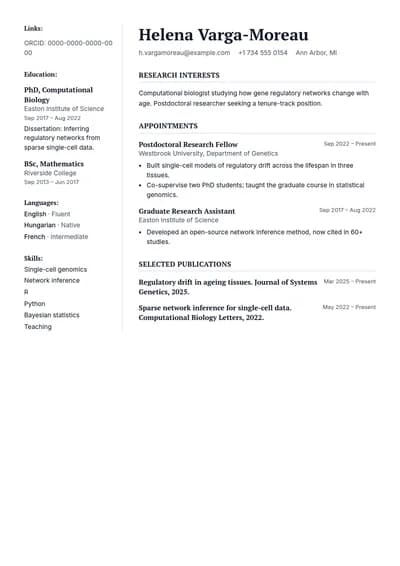
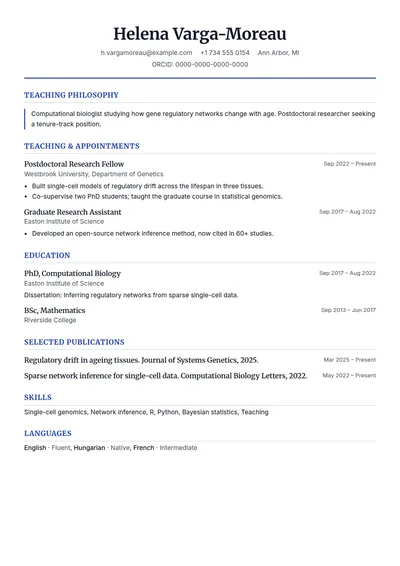
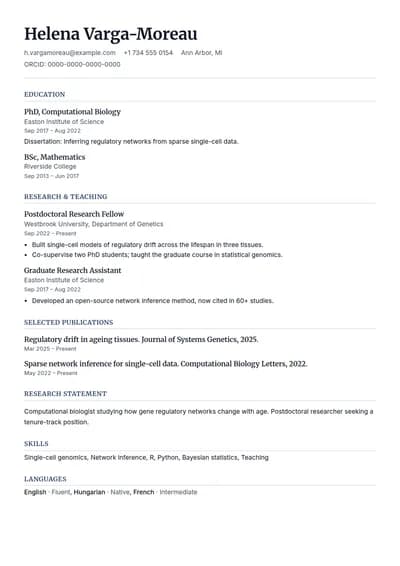
If you are still an undergraduate, start with the pre-med student example; the clinical hours there become the activities section here. Students in other health doctorates can compare the pharmacy student example, which handles rotations the same way. The Scholar template is built for a two-page CV with publications; the Fellow template is an alternative with a two-column layout.

Updated . The person and employers in this Sample resume are fictional.

Want a blank version to fill in? The medical student resume template is a free Word and Google Docs file.

Medical Student sample resume

Olumide Fashola

MD Candidate, Class of 2027 | USMLE Step 1 Passed | Internal Medicine Research

Houston, TX[email protected](713) 555-0125

Summary

Third-year medical student at Gulf Coast College of Medicine (MD expected May 2027) who passed USMLE Step 1 in June 2025 and has completed core clerkships in internal medicine, surgery, pediatrics and family medicine with honors in internal medicine. Two years as a research assistant on a heart failure readmission cohort study, first author on one accepted abstract and co-author on a manuscript under review. Scheduling officer for a student-run free clinic serving 1,200 visits a year. Applying for internal medicine sub-internships and away rotations for fall 2026.

Experience

Student Research Assistant, Heart Failure Outcomes Group, Gulf Coast College of Medicine Department of Internal Medicine

– Present

Houston, TX

  • Abstracted clinical variables for a retrospective cohort of 1,850 heart failure admissions from the electronic health record using a REDCap instrument I helped design, with a 2 percent discrepancy rate on double-entered charts.
  • First author of an abstract on 30-day readmission predictors accepted as a poster at a national internal medicine meeting (April 2026); co-author on the full manuscript, under review.
  • Ran descriptive and logistic regression analyses in R under the biostatistician's supervision and produced the tables for the manuscript.
  • Present project updates at the division's monthly research meeting and coordinate the two first-year students who joined the abstraction team.
Scheduling Officer and Student Clinician, Buffalo Bayou Community Clinic (student-run free clinic)

– Present

Houston, TX

  • Schedule 24 student volunteers and six attending preceptors across two clinic evenings a week, about 1,200 patient visits a year, with no unstaffed sessions in two years.
  • See patients as a student clinician: history and physical, presentation to the attending, documentation and discharge counseling, roughly 90 patient encounters to date.
  • Introduced a text reminder system that cut the no-show rate from about one in three to about one in six visits over one semester.
Anatomy Peer Tutor, Gulf Coast College of Medicine Office of Academic Support

–

Houston, TX

  • Led weekly cadaver lab review sessions for 15 first-year students and wrote 12 practice practical exams used by the course.
  • Every tutored student passed the anatomy practical on the first attempt, including four who had failed the midterm.

Education

Doctor of Medicine (expected May 2027)

Gulf Coast College of Medicine, Houston, TX

USMLE Step 1: Pass (June 2025). Step 2 CK scheduled July 2026. Core clerkships completed: Internal Medicine (Honors), Surgery, Pediatrics, Family Medicine; Psychiatry, Obstetrics and Gynecology and Neurology in progress. Gold Humanism nominee, class of 2027. Internal Medicine Interest Group co-president.

Bachelor of Science in Biochemistry, summa cum laude

Brazos Valley State University, Bryan, TX

GPA 3.9. Honors thesis on enzyme kinetics of a bacterial beta-lactamase.

Skills

  • History and physical examination
  • Oral case presentation
  • Clinical documentation (Epic)
  • Chart abstraction and REDCap
  • R for descriptive statistics and regression
  • Literature review and citation management (Zotero)
  • Abstract and poster preparation
  • IRB protocol amendments
  • Patient counseling and discharge teaching
  • Yoruba (native) and Spanish (medical, intermediate)
  • Teaching and small-group facilitation

Certifications

  • Basic Life Support (BLS), American Heart Association,
  • Advanced Cardiovascular Life Support (ACLS), American Heart Association,
  • CITI Biomedical Research and Good Clinical Practice, CITI Program,
Start yours from this example

Opens this sample in the editor, in one of the templates below. Swap in your details, then tailor it to each posting in about two minutes.

Use this example

Already have a medical student resume? Check it against a posting

Paste your resume and the posting you want. The keyword match, the terms you are missing and the biggest fix show here as you type, in your browser. Nothing is sent until you ask for the version written for that posting.

Check your fit — free, no account

Worked out in your browser as you type. Nothing is sent.

Result

A staff nurse's resume against a charge nurse posting. Paste yours to see your own.

33%

13 of the posting's 40 terms are on this resume.

Missing
  • coordinate
  • shift
  • staffing

Biggest fix: 2 bullets open with a duty, not a result.

A keyword match, not a verdict from any applicant tracking system.

Templates for the medical student resume

All templates

How to write a medical student resume

  1. Decide whether the reader wants a CV or a one-page resume

    Check what each application asks for before you format anything. A research mentor, a summer research program, a scholarship committee or a non-clinical job during school will often ask for a "resume" and be happy with one or two pages. Away rotation offices and residency programs want the full CV, and the residency application itself goes through ERAS, which has its own experiences section with set fields and a character limit for each description.

    Keep one master CV with everything on it, then cut a short version for the applications that ask for a resume: education, Step status, your strongest research entry and your main clinic or leadership role, nothing from before college. When a posting says "CV or resume", send the CV. The Scholar template handles the long version, and a single-column layout such as the Campus template suits the one-page cut.

  2. Put school, class year and exam status in the first lines

    Residency coordinators, rotation offices and research mentors all start in the same place: which school, which class, and where you stand on licensing exams. Make that visible without scrolling. A headline can carry all three, as in "MD Candidate, Class of 2027 | USMLE Step 1 Passed". DO students list COMLEX Level 1 the same way, alongside Step 1 if they took both.

    Add the next exam with its month so the reader can see your timeline, and change the line on the day a result arrives. Put a specialty in the headline only when every application in this round is for that specialty. A student applying for both a research year and a surgery sub-internship needs two versions of the top line, not one that tries to fit both readers.

  3. Write every research project as a job entry

    Research is where most medical student CVs stay vague. Give each project its own entry with your title (student research assistant, summer research fellow), the department or lab, the city and the dates. Then write two to four bullets covering the question the study asked, the design and sample size, the parts you did yourself and what came out of it. "Built the chart review instrument and abstracted 400 of the 1,850 admissions" tells a program director far more than "assisted with data collection".

    Put the outputs in a separate publications and presentations section in citation form, with your name in bold. If a project ended without a paper, list it anyway with what you learned to do there: an IRB amendment, a statistical method, a literature search that became part of someone else's review.

  4. Show clerkships as evidence, not as a transcript

    Your MSPE and transcript already carry every grade, so the CV does not need to repeat them. List the core clerkships you have finished in one line under the MD entry, mark honors or high pass where you earned them, and name the ones in progress so a rotation office can see you are eligible.

    Electives and sub-internships get their own lines once you have done them, with the service and the type of hospital, because a sub-internship in your chosen specialty is the closest thing a student has to a work history in it. If a clerkship produced something concrete, such as a case report, a quality project on the ward or a teaching award voted by residents, add it as a bullet in the right section instead of leaving it in an awards list at the end of page two.

  5. Give leadership and service the same structure as research

    Free clinics, interest groups, curriculum committees and tutoring programs show that you can carry responsibility before residency hands you patients of your own. Treat each one as a role, with a title, the organization, dates and two or three bullets. Count something in every bullet: clinic sessions staffed, students tutored, patients seen, workshops run, money raised for a clinic fund.

    Programs value continuity, so one organization held for three years with a rising title reads better than six memberships on a single line. Work from before medical school belongs only if it continued or explains your path, such as years as an EMT, a scribe or a medical assistant that drew you to the specialty you are now applying to.

  6. Keep a running CV from first year

    The students with the cleanest CVs in fourth year are the ones who added each item the week it happened. Keep one file with every poster, abstract, talk, tutoring term, award and certification, with exact dates and author order. The residency application asks for the same details, and you will not remember them during application season.

    Each time you apply for something smaller, such as a summer program, an away rotation or a scholarship, copy the master file and cut it down for that reader. Before sending any version, check that meeting and journal names are written in full and that your BLS and ACLS dates have not lapsed. The research assistant example shows how a research-heavy history reads when it has to fit on one page.

Medical Student resume summary examples

Three sentences at the top of the page, written for where you are now.

First-year student applying for a summer research program

First-year medical student (MD expected 2029) with a biochemistry degree and two years of undergraduate lab work in protein expression. Comfortable with literature searches, Excel and introductory R, and looking for a summer clinical outcomes project that can lead to an abstract. Available full time from June through mid-August.

Third-year student requesting an emergency medicine away rotation

Third-year medical student with USMLE Step 1 passed and honors in the surgery clerkship, completing a quality project on emergency department boarding times. Two years as a student clinician at a free clinic, presenting new patients to attendings every week. Requesting a four-week emergency medicine rotation in fall 2026.

DO student taking a research year

Osteopathic medical student who has passed COMLEX Level 1 and USMLE Step 1 and is taking a dedicated research year before residency applications. Co-author on two orthopedic surgery abstracts, trained in REDCap database design and regression in R. Seeking a funded research fellowship in orthopedics or sports medicine.

Fourth-year student, short CV for a scholarship committee

Fourth-year medical student applying to family medicine, with four years of service at a student-run free clinic and a rural track clerkship in a critical access hospital. First author on a published case report and a regional poster on hypertension follow-up. Conducts patient interviews in Spanish.

How the resume changes with experience

The same medical student resume, written at three levels: a summary and three bullets for each.

Entry level

Zero to two years, or a first role in the title

First-year medical student finishing the preclinical foundations block, volunteering at the student-run clinic and joining a clinical research group for the summer between first and second year.

  • Completed the first-year curriculum with a pass in every block and a top-quartile anatomy practical score.
  • Volunteered at ten free clinic sessions as an intake student, taking histories and vitals for about 40 patients.
  • Chose a clinical outcomes project for the summer over a bench lab, to learn chart abstraction and statistics that transfer to any specialty.

Mid level

Three to seven years, owns a process or a workload

Third-year medical student with Step 1 passed, honors in the internal medicine clerkship, a first-author national abstract and two years as a free clinic officer, applying for internal medicine sub-internships and away rotations.

  • Abstracted data for an 1,850-patient heart failure cohort and ran the regression analyses for the manuscript.
  • Cut the free clinic no-show rate roughly in half with a text reminder system.
  • Picked an away rotation at a county hospital program rather than a name-brand one because its patient mix matches the career goal.

Senior

Eight years or more, leads people, budgets or programs

Fourth-year medical student with Step 2 CK complete, two sub-internships in internal medicine, one peer-reviewed publication and two national posters, applying to categorical internal medicine residency programs this cycle.

  • Carried four to six patients independently as a sub-intern, writing all notes and orders for attending co-signature, and received the clerkship's top evaluation tier.
  • Published the heart failure readmission study in a peer-reviewed journal as second author and presented the follow-up poster at a national meeting.
  • Applied to a mix of academic and community programs weighted toward those with a primary care track, instead of ranking purely by reputation.

More medical student resume bullet points

Pick the ones that are true for you, then put your own numbers in.

Research and scholarship

  • Designed a 42-field REDCap instrument for a retrospective sepsis review and trained three classmates to use it, double-entering one chart in ten to check accuracy.
  • Screened 1,300 abstracts as one of two independent reviewers for a systematic review of telehealth follow-up after discharge.
  • Drafted the methods and results sections of a manuscript accepted by a peer-reviewed pediatrics journal after two rounds of reviewer comments.
  • Presented a poster on emergency department boarding at a regional meeting and fielded questions from two program directors at the session.

Clinical work as a student

  • Followed three patients at a time on the general medicine sub-internship, presenting each on rounds and writing daily progress notes for co-signature.
  • Wrote up an atypical presentation of endocarditis as a case report with the inpatient attending, now under review.
  • Led a ward project that moved routine morning lab draws earlier so results were back before rounds on most days of the rotation.
  • Took histories and vital signs in Spanish for about 60 patients at a migrant health clinic during a summer elective.

Teaching and leadership

  • Organized eight board review sessions for 70 second-year students and recruited a resident to lead each one.
  • Co-led the surgery interest group, running two suturing workshops and a shadowing sign-up that matched 40 first-years with surgeons.
  • Represented the class on the curriculum committee and brought student feedback on clerkship scheduling to three meetings.
  • Raised $6,500 for the student-run clinic's medication fund through a charity 5K the group still holds every spring.

Skills to put on the medical student resume

Hard skills

USMLE Step status
Program coordinators filter on it before they read anything else, so state the pass and the Step 2 date in the headline or the education entry.
Clerkship grades and honors
Honors in the specialty you are applying to is the single most persuasive line for a residency reader.
Research role described precisely
Authorship on an eight-name abstract means little until you say which parts of the study were yours.
Publications and posters in citation form
Residency applications ask for them in a standard format, and a CV that already lists them that way looks finished.
Statistical and data tools
REDCap, R or SPSS on the page tells a mentor you can carry a project rather than only abstract charts.
Clinical documentation and presentation
Sub-internship directors want students who can present a patient and write a note that needs little editing.
Life support certifications
BLS and ACLS are required for sub-internships and away rotations, and listing them avoids a last-minute scramble.

Soft skills

Ownership of patients
Evaluations in clerkships and sub-internships turn on whether you follow your patients closely, and your bullets should show it.
Teaching
Residents teach every day, and tutoring or leading review sessions is the earliest evidence that you can.
Reliability in volunteer leadership
Two years running a clinic schedule without a gap shows the follow-through programs look for.
Humility with feedback
Program directors ask about it in every interview; a page that shows progression from intake volunteer to officer demonstrates it.

Keywords from medical student job postings

Use the ones you can back up with a bullet. Paste the posting into the free resume keyword checker to see which of its terms your resume is missing.

  • USMLE Step 1
  • USMLE Step 2 CK
  • COMLEX Level 1
  • core clerkships
  • clerkship honors
  • sub-internship
  • away rotation
  • ERAS
  • MSPE
  • clinical research
  • REDCap
  • IRB
  • chart review
  • abstract
  • poster presentation
  • peer-reviewed publication
  • case report
  • quality improvement
  • BLS
  • ACLS
  • student-run free clinic
  • interest group leadership
  • peer tutoring
  • medical Spanish

Mistakes that cost medical student interviews

  1. Sending a one-page resume when a CV is expected

    Residency programs, away rotation offices and research mentors expect a CV with clerkships, research, presentations and publications in full. Two pages is normal. Keep a one-page resume only for non-clinical jobs during school.

  2. Listing authorship without your contribution

    Co-author, heart failure study tells a reader nothing about your skills. Add a bullet with the study design, the number of patients and the parts you did: instrument design, abstraction, analysis, drafting.

  3. Omitting Step dates

    A CV without Step 1 status or a Step 2 date makes a coordinator email you to ask. Put the pass and the next exam date in the education entry, and update it the day scores arrive.

  4. Writing clinic volunteering as a single line

    If you held an officer role or saw patients regularly, that is leadership and clinical experience. Give it an entry with the volume, your role and any process you improved.

  5. Padding with preclinical awards and high school items

    A first-year quiz bowl or a high school honor society dilutes a CV read by program directors. Keep awards to medical school and undergraduate honors that signal academic strength, such as a degree with distinction or a humanism nomination.

  6. Inconsistent formatting of citations

    List every abstract, poster and manuscript the same way: authors in order with yours in bold, title, meeting or journal, date, status. Coordinators notice when one entry is a sentence and the next is a citation.

Write bullets with the XYZ formula: what changed, the number that shows it, and how you did it, in one line.

Questions about the medical student resume

What is the difference between a medical student CV and a resume?

A CV lists everything relevant in full: education, Step status, clerkships, research with publications and presentations, leadership, volunteering, awards and certifications, usually over two pages. A resume is one page and summarizes. Residency, sub-internship and research applications want the CV.

How do I list USMLE Step 1 on my CV now that it is pass or fail?

Write USMLE Step 1: Pass with the month and year under your medical degree. Add Step 2 CK with the scheduled date or your score once you have it. A strong Step 2 score belongs on the CV; a weak one can be left to the application itself.

Should I include research that has not been published yet?

Yes. List it under research experience with your role and the status: data collection ongoing, abstract submitted, manuscript in preparation or under review. Move it to a publications section once accepted, with the full citation.

How do I show clerkship honors without listing every grade?

In the education entry, list the completed clerkships and mark the ones with honors or high pass. Do not list passes individually; the transcript carries them, and a line that reads Internal Medicine (Honors) does the work.

What do away rotation and sub-internship applications look for on the CV?

Step 1 status, the completed core clerkships that make you eligible, life support certifications, and interest in their specialty shown through research, interest group leadership or electives. Keep the summary short and specific to the specialty you are requesting.

How long should a residency application CV be?

Two pages for most students; three is acceptable with substantial research output. Everything on it should be verifiable, because the application system asks for the same items and interviewers compare them.

Is my ERAS application the same as my CV?

No. ERAS asks you to enter experiences, publications and presentations into its own fields, each with a character limit, so the long bullets on your CV have to be shortened there. Build the CV first and copy from it, so dates, titles and author order match. Rotation offices, research mentors and some interviewers still ask for the CV itself.

Every application goes out fitting the job.

Paste a posting, get a resume written for it in two minutes.

Tailor your resume — free

Free to start. No card. Same price on web, iOS and Android.