Solicitor CV Example (Ireland)

A Solicitor CV in Ireland is read by a partner or a head of legal who wants three things settled on the first page: that you are on the Roll of Solicitors with a current practising certificate, which practice area you have actually run files in, and what those files were worth to the firm. Partners count years post-qualification, so write the year you were admitted next to your name, and describe your caseload in the terms a fee earner uses: the number of matters, the courts, the values and who instructed you.

The Sample CV below belongs to a Solicitor four years post-qualification in commercial litigation and employment law at a mid-sized Dublin firm, who trained at a regional practice in Limerick. Its bullets name the courts, the stages of each matter and the outcomes a partner reports to the client, and its training section shows the PPC and the training contract in the order the Law Society lays them out.

Change the emphasis for each vacancy. A litigation post wants motions, discovery and trial preparation; a conveyancing post wants completions and Property Registration Authority dealings; an in-house role wants contract review and advising the business without a partner to check your work. The US counterpart of this page is the attorney resume example, written for American law firms where the title, the bar and the paper size are all different. The Chair template suits a legal CV that will be read in print.

Updated . The person and employers in this Sample CV are fictional. Written for applicants in Ireland; the page for applicants in the US is the attorney resume example.

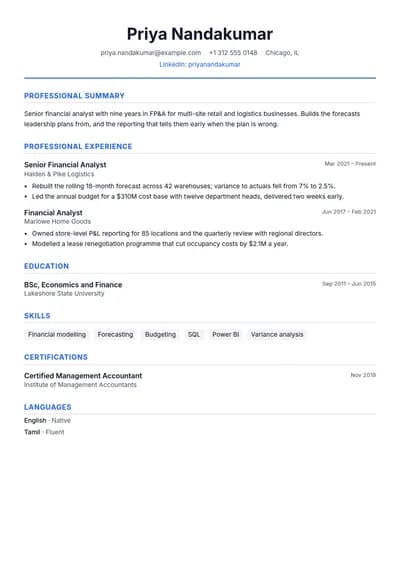
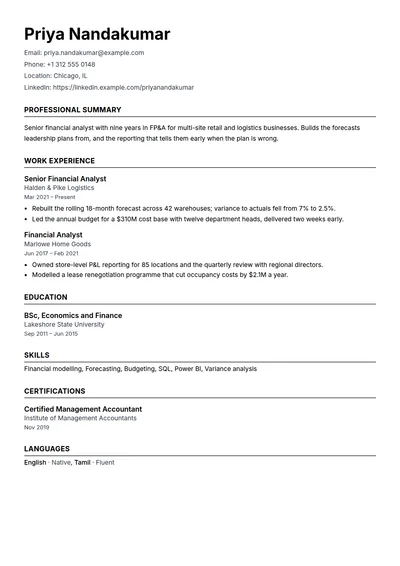
Solicitor sample CV

Drawn at A4 proportions, the paper an Irish CV is printed on.

Síofra Mulqueen

Solicitor, admitted 2022, commercial litigation and employment law

Dublin 4siofra.mulqueen@example.com087 555 0146

Summary

Solicitor four years post-qualification with a current practising certificate, running a caseload of commercial litigation and employment matters in the High Court, the Circuit Court and before the Workplace Relations Commission. Trained in a general practice in Limerick, so comfortable with a landlord and tenant dispute on Monday and a shareholder action on Tuesday. Trusted by two partners to run High Court matters to hearing with supervision only at the key decisions, and known for settlements that hold.

Experience

Associate Solicitor, Litigation and Employment, Kavanagh Rourke Solicitors LLP

– Present

Dublin 2

  • Run a caseload of around 35 live matters, including three High Court commercial actions with claims above €1 million, for clients in construction, retail and technology.
  • Defended an unfair dismissal claim before the Workplace Relations Commission for a retail client and secured a finding in the employer's favour on the first hearing day after cross-examining the complainant on the disciplinary record.
  • Drafted the pleadings, affidavits and discovery requests in a shareholder oppression petition that settled at mediation for a fraction of the amount claimed, with the partner describing the discovery schedule as the reason the other side came to the table.
  • Advise HR teams at four retained clients on investigations, disciplinary procedures and redundancy consultations, with a written note on each file that a partner can pick up if the matter turns contentious.
  • Supervise two trainee solicitors on their litigation rotation, reviewing their motion papers and sitting with them at their first Circuit Court callovers.
Solicitor, General Practice, Daly Hourigan and Co. Solicitors

–

Limerick

  • Ran residential conveyancing files from contract to registration, closing more than sixty sales and purchases in sixteen months with no requisition left outstanding at completion.
  • Handled personal injury claims through the Injuries Resolution Board and into the Circuit Court, settling most at the first settlement meeting.
  • Drafted wills and enduring powers of attorney, and administered estates from the grant of probate to the final distribution.
Trainee Solicitor, Daly Hourigan and Co. Solicitors

–

Limerick

  • Completed rotations in conveyancing, litigation, probate and family law under the training contract, keeping a record of experience signed off at each stage.
  • Attended the Circuit Court and the District Court weekly with the litigation partner, taking attendance notes and preparing the briefs for counsel.

Education

LLB (Hons) Law

University of the Mid-West Plains, Limerick

First class honours. Moot court finalist in the final year. FE-1 examinations passed in a single sitting in 2019; Professional Practice Courses I and II completed in 2021 and admitted to the Roll of Solicitors in 2022.

Skills

  • Commercial litigation in the High Court and Circuit Court
  • Employment law and Workplace Relations Commission hearings
  • Pleadings, affidavits and motions
  • Discovery and document review
  • Mediation and settlement negotiation
  • Residential conveyancing
  • Probate and estate administration
  • Client care and fee estimates under the Legal Services Regulation Act
  • Anti-money laundering checks
  • Case management and time recording systems
  • Supervising trainees

Certifications

  • Practising certificate, current, Law Society of Ireland,
  • Professional Practice Course I and II, Law Society of Ireland,
  • Diploma in Employment Law, Law Society of Ireland,
  • Certified Mediator, Mediators' Institute of Ireland,
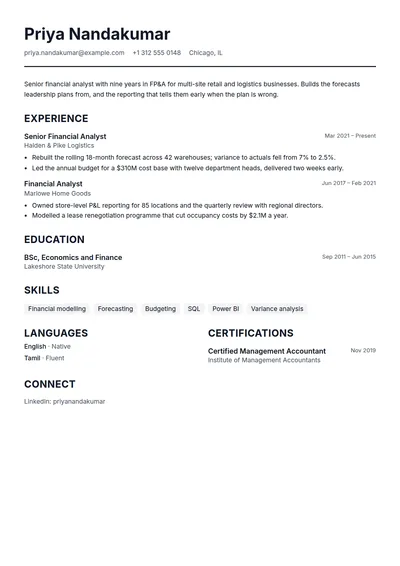
Start yours from this example

Opens this sample in the editor, in one of the templates below. Swap in your details, then tailor it to each vacancy in about two minutes.

Use this example

How an Irish CV differs

An Irish Solicitor CV is built around the Law Society of Ireland's route to the profession, not a state bar examination. A reader expects the FE-1 examinations, the Professional Practice Courses, the training contract and the year of admission to the Roll, followed by the practising certificate for the current year. The profession is split between solicitors and barristers, so the CV describes instructing counsel and appearing in the District and Circuit Courts rather than trial advocacy in the American sense, and it names Irish courts, Irish statutes and Irish bodies such as the Workplace Relations Commission and the Injuries Resolution Board throughout.

For a solicitor in Ireland

  1. The year of admission next to your name

    Partners count years post-qualification before anything else. Write the year you were admitted to the Roll in the headline, and the current practising certificate in the training section, so the reader can place you in the firm's structure at a glance.

  2. The Law Society route, in order

    List the FE-1s, PPC I and PPC II and the training contract with the firm and the dates. A reader checks that the sequence is complete; a gap or a missing stage raises a question before the interview.

  3. Describe files, not duties

    Give the number of live matters, the courts, the value bands and who you reported to. Responsible for a caseload of litigation files says nothing; thirty-five live matters including three High Court actions above one million euro says everything a partner needs.

  4. Solicitor and barrister, not attorney

    Write about instructing counsel, briefing a barrister for a hearing and attending consultations. Attorney, bar admission and litigator read as American and tell an Irish partner the CV was written for somewhere else.

  5. No client names

    Describe clients by sector and size. Naming a client on a CV breaches confidentiality and is the kind of error that ends an application at a careful firm.

Every CV in Ireland

A4 paper
The page is A4. Irish employers print and file on A4, and a Letter-sized PDF is the first sign a CV was written for the US.
Two pages is normal
Two pages is the norm for an Irish CV. Graduates fit one; nobody needs three unless the role is senior.
No photo
No photo, date of birth or marital status. Irish employers do not ask for them, and leaving them off keeps the page about the work.
Dates as DD/MM/YYYY
Day, month, year where a full date appears; month and year for each role. The US month-first order confuses the reader.
Irish English
Irish English follows British spelling: organise, programme, centre, licence, specialise.
Town or Dublin postal district, not a street address
"Dublin 8" or "Cork" is enough on the contact line. A full address is not expected, and the US-style "City, ST 12345" line never is.

More on applying in Ireland, with every CV example for it, on the Ireland page.

Templates for the solicitor CV

All templates

Every template exports on A4. The previews are drawn on Letter; the editor sets the page size when you export.

How the CV changes with experience

The same solicitor CV, written at three levels: a profile and three bullets for each.

Entry level

Zero to two years, or a first post in the title

Newly qualified Solicitor, admitted this year after a training contract in a general practice, with rotations in conveyancing, litigation and probate and a first class LLB.

  • Completed a three-year training contract with rotations across four practice areas, signed off at each stage by the training solicitor.
  • Ran twenty residential conveyancing files to completion under supervision in the final year of training.
  • Attended court weekly with the litigation partner and drafted the first version of pleadings and affidavits on a dozen Circuit Court matters.

Mid level

Three to seven years, owns a process or a workload

Solicitor five years post-qualification in commercial property, running acquisitions, leases and development finance for institutional and private clients.

  • Act on commercial property transactions with values between €500,000 and €20 million, from heads of terms to registration.
  • Draft and negotiate commercial leases, agreements for lease and licences for a portfolio landlord with more than forty tenancies.
  • Manage the title and planning due diligence on a mixed-use development, coordinating the planning consultant and the lender's solicitors.

Senior

Eight years or more, leads people, budgets or programmes

Partner with fourteen years in insolvency and restructuring, leading a team of five solicitors and the firm's relationship with two of the main Irish lenders.

  • Advise receivers, liquidators and lenders on enforcement and restructuring, including examinerships and the Small Company Administrative Rescue Process.
  • Lead a team of five solicitors and two trainees, with responsibility for fee targets, work allocation and the team's annual review.
  • Brought in two institutional clients through seminars and a published commentary on the Companies Act.

Skills to put on the solicitor CV

Hard skills

A practice area you can describe in files
Irish firms hire by practice area, and a partner wants to know what you have run alone, not what you have observed.
Drafting
Pleadings, contracts and advice letters are the product; a partner will read your CV as a drafting sample before they read it as a history.
Court procedure
Knowing the Rules of the Superior Courts and the Circuit Court Rules well enough to move a motion without a precedent file saves a partner time at every stage.
Negotiation and mediation
Most Irish disputes settle, and a solicitor who settles on good terms early is worth more to a client than one who wins late.
Client care and costs
Section 150 letters, fee estimates and updates are regulated duties, and a solicitor who keeps clients informed produces fewer complaints to the Legal Services Regulatory Authority.
Regulatory compliance
Anti-money laundering checks, the Solicitors Accounts Regulations and data protection are part of every file, and firms want to see you know them.

Soft skills

Judgement
A partner wants to know which decisions you escalate and which you take, and the interview will test it with a scenario.
Resilience
Hearings, deadlines and difficult clients arrive together, and a firm notices the solicitor who stays even and keeps the file moving.
Clear communication
Clients pay for advice they can act on, and the best solicitors explain the position in a page rather than a memorandum.
Commercial awareness
Firms measure fee income and recovery, and a solicitor who understands what a client's business needs is given the better work.

Mistakes that cost solicitor interviews

  1. Years post-qualification left to be worked out

    If a partner has to count back from your PPC date to find your experience level, you have already lost a minute of attention. Write admitted in a stated year in the headline and keep the dates in your training section consistent with it.

  2. A caseload with no numbers

    Assisted on a range of litigation matters could describe a trainee or a senior associate. Give the number of files, the courts, the value bands and the stage you took them to, and name one or two outcomes.

  3. Listing every rotation as if it were a specialism

    A training contract covers four or five areas; that does not make you a specialist in each. Lead with the practice area you want to work in and describe the others in a line, or the reader cannot tell what you are applying for.

  4. American or English vocabulary

    Attorney, paralegal supervisor, bar exam and SRA belong to other jurisdictions. Use the Law Society, the Roll, the practising certificate and Irish court names, and write in Irish English.

  5. Forgetting continuing professional development

    The Law Society requires CPD hours every year and firms ask about them. A diploma in employment law or a mediation qualification shows direction, and a current CPD record shows you take the regulation seriously.

  6. A three-page CV at four years post-qualification

    Partners read a CV between meetings. Two pages is enough for anyone under ten years qualified; trim the trainee bullets to two lines and let the current role carry the detail.

Write bullets with the XYZ formula: what changed, the number that shows it, and how you did it, in one line.

Questions about the solicitor CV

How do I describe my practising certificate on a CV?

Write practising certificate, current, with the year, in your professional training section, directly after your admission to the Roll. If you are between certificates or applying from abroad, say so plainly rather than leaving the line out, because the firm will check with the Law Society.

Should a newly qualified solicitor list every training rotation?

List them in one block under the training contract, with the months in each, and give two or three bullets on the area you are applying for. A newly qualified solicitor's CV is read for the quality of the training firm and the depth of the relevant rotation, not for breadth.

How long should a Solicitor CV be in Ireland?

Two pages of A4. A newly qualified solicitor can fit on one and a half; a partner-level CV with a client following and publications may stretch to three, but a mid-level associate who needs three is usually including too much from the training years.

Do I include my FE-1 results?

Include the fact that you passed and how many sittings it took if that is to your credit. Individual subject marks are not expected. The same applies to the PPC: the Law Society does not grade it in a way firms compare.

How do I write a CV for an in-house legal role?

Lead with the commercial advice you have given and the business areas you have supported, and move court work lower. In-house recruiters want to see that you can advise without a partner reviewing your work, so name the decisions you took alone and the stakeholders you dealt with.

Can I use a legal CV from England or the US in Ireland?

Not without rewriting it. The qualification route, the court names, the regulators and the vocabulary are all different, and an Irish partner will notice within a paragraph. Drop the Irish job specification into Resume Master and it reshapes the CV around the firm's own wording, in Irish English.

Every application goes out fitting the vacancy.

Paste a vacancy, get a CV rewritten for it in about two minutes.

Tailor your CV — free

Free to start. No card. Same price on web, iOS and Android.