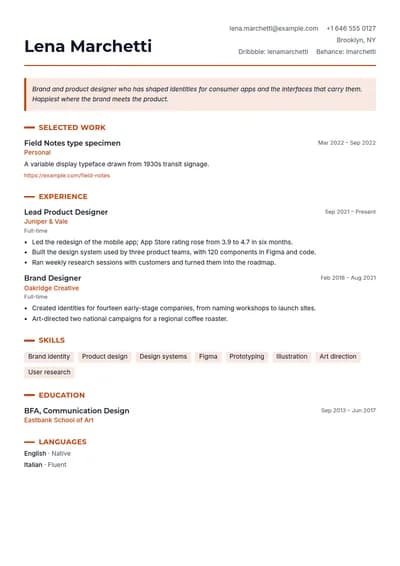
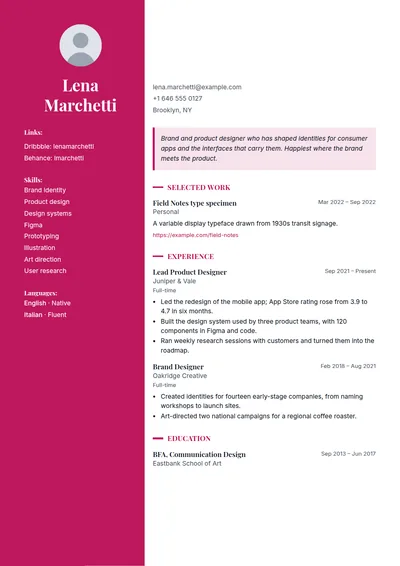
Illustrator Resume Example

Illustrators are hired from the portfolio, but the resume decides whether an art director clicks the link. It should say what you draw, who you have drawn it for and how reliably you deliver.

The Sample resume below belongs to an illustrator with seven years of work: a staff role at a children's publisher and a freelance practice with editorial and packaging clients. Bullets describe projects the way art directors think about them: format, number of pieces, deadline, and what the client did next, such as a reprint, a series or a repeat commission. Software and mediums sit in one short skills list.

Match the page to each application. A publisher wants to see books and consistency across a long project; an agency or studio wants range, speed and comfort with feedback. Freelancers can list their practice as a job with the best clients as bullets. Browse more pages in the creative and design hub, and the Canvas template keeps a portfolio line in plain view.

Updated . The person and employers in this Sample resume are fictional.

Want a blank version to fill in? The illustrator resume template is a free Word and Google Docs file.

Illustrator sample resume

Leah Morrow

Illustrator, Children's Books, Editorial and Packaging

Portland, OR[email protected](503) 555-0127

Summary

Illustrator with seven years of experience creating picture books, editorial spots and packaging art in a warm, textured digital style. Illustrated eleven published children's books, two of which went to a second printing within a year. Delivers sketches on time, handles revision notes without drama and keeps files print-ready from the first round.

Experience

Freelance Illustrator, Leah Morrow Illustration

– Present

Portland, OR

  • Illustrate editorial spots and features for regional magazines and newsletters, usually on turnarounds of three to five days.
  • Created label art for a line of six craft sodas; the client extended the series to four seasonal flavors the following year.
  • Manage contracts, invoices and usage rights for twelve to fifteen clients a year, with most work coming from repeat commissions.
Staff Illustrator, Owlbrook Press

–

Portland, OR

  • Illustrated eleven picture books of 32 to 40 pages each, from thumbnails through final art, working with three editors.
  • Designed recurring characters for a six-book early reader series and wrote the character sheet other illustrators followed.
  • Prepared final files for print, reducing color correction requests from the printer to almost none after the first two titles.
  • Created cover art and interior spot illustrations for the spring and fall catalogs.

Education

B.F.A. in Illustration

Coastal Range College of Art and Design, Portland, OR

Skills

  • Procreate
  • Adobe Photoshop
  • Adobe Illustrator
  • InDesign
  • Character design
  • Picture book layout
  • Editorial illustration
  • Packaging and label art
  • Hand lettering
  • Print-ready file preparation
  • Gouache and ink
  • Contracts and licensing basics

Start yours from this example

Opens this sample in the editor, in one of the templates below. Swap in your details, then tailor it to each posting in about two minutes.

Use this example

Already have an illustrator resume? Check it against a posting

Paste your resume and the posting you want. The keyword match, the terms you are missing and the biggest fix show here as you type, in your browser. Nothing is sent until you ask for the version written for that posting.

Check your fit — free, no account

Worked out in your browser as you type. Nothing is sent.

Result

A staff nurse's resume against a charge nurse posting. Paste yours to see your own.

33%

13 of the posting's 40 terms are on this resume.

Missing
  • coordinate
  • shift
  • staffing

Biggest fix: 2 bullets open with a duty, not a result.

A keyword match, not a verdict from any applicant tracking system.

Templates for the illustrator resume

All templates

How to write an illustrator resume

  1. Name your style and your markets in the headline

    An art director sorting submissions wants to know in one line whether you draw the kind of work they buy. Write the markets you serve and, if it fits, the look: "Illustrator, Picture Books and Editorial" or "Digital Illustrator, Game Characters and Packaging". Put the portfolio address in the header as plain text, and point it at the section that matches the job rather than the home page, such as a children's work page for a publisher. Add your city and say "remote" if you work with clients anywhere, because many commissions never meet in person. If an agent represents you, add the agency name on its own line so a buyer knows whom to contact about rates and availability.

  2. Write a summary an art director could repeat in a meeting

    Art directors often pitch an illustrator to an editor or a client, so give them the sentence they will use. Describe your style in plain words a non-artist understands (warm gouache textures, flat bold vector shapes, loose ink line and watercolor wash), then the formats you deliver: picture books, spot illustrations, covers, labels, character sheets. Close with proof of reliability, such as the number of books published, a reprint, a series that was extended or the share of work that comes from repeat clients. "Illustrated nine picture books, three of them in a single series, every one delivered on the publisher's schedule" says more than "passionate visual storyteller".

  3. Describe projects by format, volume and deadline

    Each bullet should let a reader picture the job: what was made, how many pieces, at what size or length, on what schedule, and what happened next. "Painted 14 spreads and a cover for a 32-page picture book in 16 weeks, approved at the first color pass" tells an editor you can carry a long project. "Turned around a full-page magazine opener in four days" tells an agency you can absorb a crisis. Outcomes that illustrators can honestly claim include reprints, series extensions, repeat commissions, a client reusing the art in other channels, and final files accepted without printer corrections. The XYZ formula post shows how to keep the action, the number and the method in one line.

  4. Present a freelance practice as a business

    List freelance work as a job with your studio name or your own name as the employer and the year you started. Under it, use bullets for the strongest commissions, grouped by market if you work across books, editorial and packaging. Name a client only if the contract allows it; otherwise describe it, such as "a regional craft brewery" or "a national parenting magazine". Add one bullet that shows you run the practice well: usage and licensing terms you negotiate, kill fees in your contracts, the number of clients a year, the share who book again. Publishers and agencies read this as a sign you will not need hand-holding on paperwork, which matters as much as the art when they choose between two similar portfolios.

  5. Separate software, mediums and illustration skills

    Use three labeled lines so a reviewer and an applicant tracking system both find what they need. Software: Procreate, Adobe Photoshop, Adobe Illustrator, InDesign, Clip Studio Paint, or Blender if you block out scenes in 3D before painting. Mediums: gouache, ink, watercolor, colored pencil, only the ones you deliver final work in. Skills: character design, visual development, picture book layout, storyboarding, hand lettering, surface pattern repeats, print-ready file preparation. Copy the posting's wording when it is true for you, since a studio searching for "concept art" may not match "visual development". Leave out techniques you tried once in school; a short list keeps the style clear.

  6. Add the credits an art director checks

    Below the experience, a short Credits or Publications section lists published books with the publisher and year, notable editorial placements, juried annuals or exhibitions, and any awards. Keep it to the six to ten strongest items, newest first, and skip small group shows unless you are early in your career. Education goes last: the degree, school and year, plus a thesis project if it is a published or well-known piece. Teaching a workshop or a college course belongs here too, because it shows you can explain process to editors and junior artists. Browse other creative pages in the creative and design hub, and the graphic designer example if you also sell layout and branding work.

Illustrator resume summary examples

Three sentences at the top of the page, written for where you are now.

Freelance editorial illustrator

Editorial illustrator with six years of freelance work for regional magazines, nonprofit reports and newsletters, drawing in a flat, bold vector style that holds up at small sizes on screen. Turns around spot illustrations in 48 to 72 hours and conceptual features in a week. About half of each year's commissions come from art directors who have booked before.

Moving into visual development for games

Digital illustrator moving into visual development for games, with four years of character and environment art for independent studios and tabletop publishers. Paints keyframes and character turnarounds in Photoshop and blocks out scenes in Blender before painting over them. Delivered 90 card illustrations for a deck-building game on a fixed monthly schedule.

Recent BFA graduate

Illustration BFA graduate (May 2026) with a portfolio of picture book spreads, editorial spots and a 24-page self-published comic. Completed three paid commissions during school, including a mural design chosen by a city arts program. Works in gouache and Procreate and keeps files ready for print at 300 dpi.

Surface pattern and licensing

Surface pattern illustrator with five years of licensing art for stationery, gift wrap and home textiles, with 60 repeat patterns in active collections. Builds seamless repeats and colorways in Illustrator and Photoshop to each manufacturer's specifications. Shows new collections at two trade fairs a year through a licensing agent.

How the resume changes with experience

The same illustrator resume, written at three levels: a summary and three bullets for each.

Entry level

Zero to two years, or a first role in the title

Illustration graduate with a portfolio of editorial and children's work and two small paid commissions. Draws quickly, follows art direction well and prepares clean digital files.

  • Illustrated a campus magazine cover and three inside spots during the final year of school.
  • Completed a paid commission of eight spot illustrations for a local nonprofit's annual report.
  • Built a dummy picture book for a senior thesis, from thumbnails to three finished spreads.

Mid level

Three to seven years, owns a process or a workload

Illustrator with five years of experience creating editorial and packaging art for clients, known for consistent characters and dependable deadlines.

  • Deliver weekly editorial spots for two regional publications.
  • Created packaging art for a snack brand's product line.
  • Keep a client list of about a dozen repeat buyers.

Senior

Eight years or more, leads people, budgets or programs

Senior illustrator and illustration lead with twelve years of experience, directing other artists on large book and game projects and setting visual standards.

  • Led the visual development for a twenty-title book series, directing four freelance illustrators.
  • Created the style guide that kept a mobile game's characters consistent across three years of updates.
  • Review portfolios and hire freelance illustrators for the studio's larger projects.

More illustrator resume bullet points

Pick the ones that are true for you, then put your own numbers in.

Books and long projects

  • Delivered 28 interior spot illustrations for a middle-grade novel two weeks ahead of the copyedit deadline.
  • Painted final art for a 40-page picture book in 18 weeks, with one round of color revisions.
  • Kept a cast of nine characters consistent across a four-book chapter series by building turnarounds and an expression sheet.
  • Illustrated a 12-page activity booklet for a museum's family program, reprinted for a second season.

Commercial and editorial work

  • Turned around a full-page magazine opener in four days after the original artist dropped out.
  • Created 16 icons and spot illustrations for a credit union's website redesign, delivered as layered SVG files.
  • Painted the label art for a limited cider release that sold out its first run of 3,000 cases.
  • Supplied monthly editorial spots to a trade newsletter for three years without missing a deadline.

Running the practice

  • Raised the average editorial fee by moving clients from flat buyouts to licensed usage terms with a fee for extended rights.
  • Built a list of 1,100 art directors and buyers and mailed a quarterly portfolio update that brought in 9 new clients in a year.
  • Wrote contracts covering kill fees, usage terms and credit lines for every project over $500.
  • Tracked 14 active commissions at once in a shared schedule so each client saw sketch and final dates up front.

Skills to put on the illustrator resume

Hard skills

A clear personal style
Art directors hire illustrators for how they draw, so describe your style plainly and make sure the portfolio shows it.
Digital tools (Procreate, Photoshop, Illustrator)
Most commissions are delivered digitally, and naming the tools tells a studio you can fit into its pipeline.
Character design and consistency
Books, series and brands need the same character to look right on every page, which is harder than a single image.
Print and file preparation
Clean, correctly sized files save a publisher time and money, and they remember who delivered them.
Working from a brief
Commercial illustration serves someone else's goal, and reading a brief well is what gets you hired again.
Licensing and usage rights
Freelancers who understand rights protect their income, and clients trust them with bigger projects.

Soft skills

Taking art direction
Revisions are part of every job, and art directors book illustrators who make changes cleanly and without delay.
Meeting deadlines
Publishing and editorial schedules are fixed, and a late illustration can hold up a whole issue or print run.
Client communication
Clear updates and early questions prevent expensive rework, especially on long projects.

Keywords from illustrator job postings

Use the ones you can back up with a bullet. Paste the posting into the free resume keyword checker to see which of its terms your resume is missing.

  • illustration
  • digital illustration
  • Procreate
  • Adobe Photoshop
  • Adobe Illustrator
  • character design
  • visual development
  • concept art
  • editorial illustration
  • children's book illustration
  • picture book layout
  • storyboarding
  • hand lettering
  • vector illustration
  • print-ready files
  • color theory
  • composition
  • art direction
  • revisions
  • portfolio
  • licensing and usage rights
  • packaging illustration
  • surface pattern design

Mistakes that cost illustrator interviews

  1. Relying on the portfolio to do everything

    Some reviewers read the resume first to decide whether the portfolio is worth their time. Give them the formats, clients and outcomes in words so the click is an easy decision.

  2. Listing every medium you have tried

    A long list of techniques blurs your style. Name the few mediums and tools you actually deliver work in, and let the portfolio show them.

  3. Treating freelance work as a gap

    Freelance illustration is a job. Give it a title and dates, describe the kinds of clients and projects, and mention repeat commissions, which show reliability.

  4. Leaving out scale and format

    One spot illustration and a forty-page picture book are very different projects. Say how many pieces, what size and on what schedule.

  5. A portfolio link that does not match the job

    If you apply to a children's publisher, open with children's work. Keep a separate page or section for editorial and packaging so each reviewer sees the right pieces first.

Write bullets with the XYZ formula: what changed, the number that shows it, and how you did it, in one line.

Questions about the illustrator resume

Do illustrators need a resume at all?

Yes, for staff roles and for many agencies and publishers who keep records of freelancers. A one-page resume next to the portfolio answers practical questions about experience and deadlines quickly.

How should a freelance illustrator list clients?

List the freelance practice as one job, then use bullets for your strongest or most relevant clients and projects. Group smaller jobs into a single line.

Should an illustrator resume include artwork?

Keep the resume text-based so it reads well anywhere, and link to your portfolio. A small image can work on a personal site, but it often breaks in an application system.

What is the difference between an illustrator and a graphic designer resume?

An illustrator's page centers on original images and style; a designer's centers on layout, typography and brand systems. If you do both, lead with the one the posting asks for.

How do I show deadlines on an illustrator resume?

Mention turnaround times, series completed on schedule and repeat clients. Those facts tell an art director you are safe to book.

How do I write a freelance illustrator resume?

Treat the practice as your current job: your studio name or your own name as the employer, the year you started, and bullets for the strongest commissions with format, quantity and turnaround. Add a line for representation if an agent handles your bookings, and keep a separate credits list for books and publications. If you also hold a part-time staff role, list both with their own dates so the overlap is clear.

Every application goes out fitting the job.

Paste a posting, get a resume written for it in two minutes.

Tailor your resume — free

Free to start. No card. Same price on web, iOS and Android.