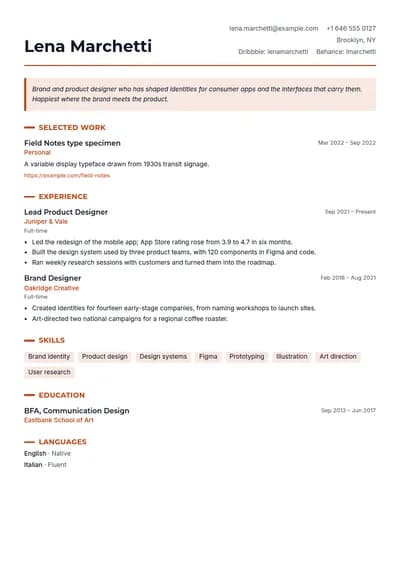
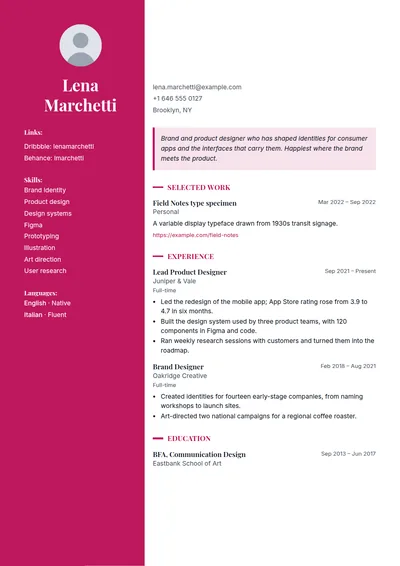
Interior Designer Resume Example

Interior designers are hired on a portfolio, then on proof they can carry a project from concept to punch list. The resume supplies that proof. It lists project types, square footage, budgets, software and how the built work turned out.

The Sample resume below is for an interior designer with six years across a hospitality-focused studio and a residential firm, working on restaurants, boutique hotel rooms and whole-house renovations. Its bullets name the project scale, the phase of work the candidate owned, the consultants coordinated and the outcome: on-budget installs, repeat clients, a published project, a specification library that saved the studio hours every week.

Shift the weight toward the practice you are applying to. Commercial and workplace studios want code knowledge, Revit and consultant coordination; residential firms want client presentation, custom millwork and sourcing; furniture dealers want space planning and specification volume. The graphic designer example covers the branding side of a hospitality project, and the art director example shows how creative leads present teams. The Portrait template leaves room for a portfolio link and a clean tools column.

Updated . The person and employers in this Sample resume are fictional.

Interior Designer sample resume

Sofia Lindqvist

Interior Designer, NCIDQ Certified, Hospitality and Residential

Denver, COsofia.lindqvist@example.com(303) 555-0173

Summary

Interior designer with six years of experience taking hospitality and residential projects from concept boards through construction administration. Led the interiors for four restaurant openings and a 42-room boutique hotel renovation, all installed within the approved FF&E budget. Skilled in Revit, SketchUp and Enscape, and trusted by contractors because the drawings answer their questions before they ask.

Experience

Interior Designer, Alder & Vine Interiors

– Present

Denver, CO

  • Lead designer on four restaurant openings between 2,800 and 6,500 square feet, producing concept packages, finish schedules and FF&E specifications that installed within budget on each one.
  • Managed interiors for a 42-room boutique hotel renovation with a $1.4M FF&E budget, coordinating with the architect, lighting consultant and general contractor through 38 weeks of phased construction.
  • Built a shared finish and furniture specification library in Revit that cut drawing set production time by roughly a day per project for the studio's three designers.
  • Present concepts directly to owners and operators; two restaurant groups returned for second locations after their first opening.
Junior Interior Designer, Meridian Loft Design Studio

–

Boulder, CO

  • Produced space plans, elevations and material boards for twelve whole-house renovations and two ground-up residences, from schematic design through construction documents.
  • Sourced and specified furniture, lighting and custom millwork for projects with budgets from $80K to $600K, tracking every order in a procurement log.
  • Ran site visits during installation and wrote punch lists that contractors closed out within two weeks on most projects.
  • Prepared a mountain residence for a regional design magazine feature, styling the shoot and coordinating with the photographer.

Education

B.F.A. in Interior Design (CIDA-accredited)

Rocky Front College of Art and Design, Denver, CO

Skills

  • Concept development and mood boards
  • Space planning
  • Revit
  • SketchUp and Enscape
  • AutoCAD
  • Adobe InDesign and Photoshop
  • FF&E specification and procurement
  • Finish schedules
  • Custom millwork detailing
  • Lighting design coordination
  • Building and accessibility codes
  • Construction administration
  • Client presentations
  • Budget tracking

Certifications

  • NCIDQ Certificate, Council for Interior Design Qualification,
  • LEED Green Associate, U.S. Green Building Council,

Start yours from this example

Bring your own resume or start blank, then tailor it to each posting in about two minutes.

Use this example

Templates for the interior designer resume

All templates

How the resume changes with experience

The same interior designer resume, written at three levels: a summary and three bullets for each.

Entry level

Zero to two years, or a first role in the title

Interior design graduate with a CIDA-accredited degree, a year of internship experience at a workplace studio and a portfolio of studio projects ranging from a clinic to a co-working space.

  • Drafted furniture plans and finish schedules in Revit for three office fit-outs during a year-long internship.
  • Assembled and maintained the studio's materials library, so designers found samples in minutes rather than reordering them.
  • Chose to redraw a reception desk detail after spotting a clearance conflict the millworker had missed.

Mid level

Three to seven years, owns a process or a workload

Interior designer with four years of experience running residential and small commercial projects from concept through installation, with a growing base of referral clients.

  • Own six to eight active projects at a time from schematic design through punch list.
  • Delivered a 5,000-square-foot medical office fit-out on schedule and under the furniture budget.
  • Steer clients away from finishes that will not hold up in the space, even when the sample is prettier.

Senior

Eight years or more, leads people, budgets or programs

Senior interior designer and studio lead with twelve years of experience directing hospitality and multifamily interiors, managing a team of five and the studio's largest client accounts.

  • Direct interiors for hotel and multifamily projects with FF&E budgets up to $6M.
  • Grew the studio's hospitality revenue by landing two hotel brand standards programs.
  • Decide which projects the team takes on, balancing fee, schedule and portfolio value.

Skills to put on the interior designer resume

Hard skills

Revit, AutoCAD and SketchUp
Firms hire for the software they draw in, and a posting almost always names it, so list exactly what you produce construction documents with.
FF&E specification and procurement
Furniture, fixtures and equipment are where budgets slip, and designers who track specifications and orders are trusted with bigger projects.
Space planning and code knowledge
Commercial studios need plans that pass plan review, and knowing egress, clearances and accessibility rules saves redesign.
Construction administration
Answering RFIs, reviewing submittals and walking punch lists show you can finish a project, not just start one.
Rendering and presentation tools
Enscape, InDesign and physical boards win client approvals, and studios want designers who can sell a concept in the room.
NCIDQ certification
Many commercial firms require or prefer it, and it separates interior designers from decorators in the hiring manager's mind.
Budget and schedule tracking
Principals want designers who know where every dollar of the FF&E budget went, because that is what the client asks them.

Soft skills

Client presentation
Projects stall when clients cannot decide, and designers who present options clearly move approvals along.
Coordination with contractors and consultants
Good working relationships with the general contractor and the lighting or MEP consultants keep drawings from being redrawn.
Attention to detail
A wrong grout color or a millwork dimension off by an inch is visible forever, and studios hire people who catch it on paper.
Managing feedback
Every project takes revisions from clients and principals, and staying open to them without losing the concept is a daily skill.

Mistakes that cost interior designer interviews

  1. No portfolio link in the header

    Principals will look at your work before your resume. Put a portfolio address on the first line under your name and make sure the link opens to finished projects, not a login page.

  2. Projects with no scale

    Designed interiors for a restaurant tells a studio very little. Add square footage, budget range, the number of rooms or seats and the phase of work you owned so they can picture your role.

  3. Confusing decorating with design

    If you have produced construction documents, coordinated consultants or handled code review, say so in plain terms. Commercial firms screen for those words and pass over resumes that only mention styling and sourcing.

  4. Listing software without proof

    Knowing Revit is common. Show what you produced with it, such as full construction document sets or a shared family library, so the interviewer knows what level you are at.

  5. Leaving out the outcome

    Installed on budget, client returned for a second location, project published: these are the results principals care about. End each project bullet with what happened after the design was built.

  6. Ignoring the studio's specialty

    A hospitality studio does not want three paragraphs on residential kitchens. Reorder your projects and rewrite the summary so the most relevant work type appears first for each application.

Questions about the interior designer resume

Should an interior designer resume include a portfolio?

Always link to one in the header. Keep the resume to project facts and results, and let the portfolio carry the images. For a specific application, add a short PDF of the three most relevant projects.

How do I list projects on an interior design resume?

Under each employer, write one bullet per notable project with its type, size, budget, your phase of involvement and the result. Group smaller projects into a single line with counts and budget ranges.

Does NCIDQ certification belong on the resume?

Yes, in the headline and in a certifications section with the year. If you have passed some sections, list them as in progress with the expected completion date; many firms will count it in your favor.

How do I write an interior designer resume with no professional experience?

Lead with your CIDA-accredited degree, internships and studio projects described like real work, with the program type, square footage and software. Add retail or hospitality jobs that show client skills. The entry variant above is a model.

Is Revit required for interior design jobs?

For most commercial and hospitality studios, yes, and many residential firms use it too. If your experience is in AutoCAD and SketchUp, say so honestly and mention any Revit coursework or self-study underway.

Every application goes out fitting the job.

Paste a posting, get a resume rewritten for it in two minutes.

Tailor your resume — free

Free to start. No card. Same price on web, iOS and Android.