Beginning Teacher CV Example (New Zealand)

A Beginning Teacher CV in New Zealand is read by a principal and often a deputy or syndicate leader who knows you have little or no classroom experience of your own. They read it for three things: that you hold or have applied for provisional certification with the Teaching Council, that your practicum placements gave you real responsibility for planning and assessment, and that you will fit their kura or school and its community. A short, honest CV that answers those questions beats a long one full of teaching philosophy.

The Sample CV below is for a primary teacher in her first year at a Hamilton school, provisionally certificated, with three practicum placements behind her and a year of relief teaching and teacher aide work. Each bullet shows something she planned, taught or assessed herself, and how she worked with whānau and her tutor teacher.

If you are applying in the United States, the US teacher resume example is written for American districts and their licensing. For New Zealand schools, keep the CV to two pages, name your referees, and see the teacher CV for New Zealand for what the next version looks like once you are fully certificated. The Launch template suits a graduate CV with placements and study near the top.

Updated . The person and employers in this Sample CV are fictional. Written for applicants in New Zealand; the page for applicants in the US is the teacher resume example.

Beginning Teacher sample CV

Drawn at A4 proportions, the paper a New Zealand CV is printed on.

Anahera Rangiwai

Beginning Teacher (Provisionally Certificated), Primary, Years 3 to 4

Hamilton, Hillcrestanahera.rangiwai@example.com021 555 0177

Summary

Provisionally certificated primary teacher in my first year, teaching a Year 3 and 4 class of 26 at a Hamilton contributing school with a tutor teacher and a full induction and mentoring programme. Three practicum placements across a rural school, a large urban school and a bilingual unit gave me planning and assessment responsibility in reading, writing and maths, and a confident start in te reo Māori and tikanga in the classroom. Looking for a fixed-term or permanent beginning teacher position in the Waikato from Term 1.

Experience

Beginning Teacher, Year 3 and 4, Tōtara Grove School

– Present

Hamilton

  • Teach a Year 3 and 4 class of 26 children, planning reading, writing and maths with the syndicate and leading the class's inquiry unit on local waterways in Term 2.
  • Use a structured literacy approach for phonics and spelling with three ability groups, and track progress against the school's assessment schedule each term.
  • Meet my tutor teacher weekly, keep an evidence folder against the Standards for the Teaching Profession and completed my first two observed lessons with written feedback.
  • Hold three-way learning conferences with children and their whānau each term, including two families I meet at home because the school day does not suit them.
Relief Teacher, Day relief across Waikato primary schools

–

Hamilton and surrounding districts

  • Covered 31 days of relief across six schools in Term 4, from new entrants to Year 8.
  • Followed each class teacher's plan and left a written note on what was covered and how each group got on.
Teacher Aide (part-time, alongside study), Pūkeko Hill School

–

Hamilton

  • Supported two children with learning support funding in a Year 5 and 6 class for twelve hours a week.
  • Ran small-group reading sessions planned by the class teacher and recorded running records for the team.
  • Helped at the school's kapa haka practice and on two overnight camps.

Education

Bachelor of Teaching (Primary)

Kahikatea University, Hamilton

Practicum placements: a two-teacher rural school (Years 1 to 8), a Year 2 class at a large urban school, and a Level 2 Māori immersion unit.

Skills

  • Planning against the New Zealand Curriculum
  • Structured literacy and phonics
  • Maths with manipulatives and group rotation
  • Running records and reading assessment
  • Formative assessment and learning conferences
  • Te reo Māori and tikanga in the classroom
  • Working with whānau
  • Behaviour support and restorative conversations
  • Supporting learners with additional needs
  • Google Workspace for Education and Seesaw
  • Current first aid certificate
  • Full New Zealand driver licence

Certifications

  • Provisional Practising Certificate (Tōmua), Teaching Council of Aotearoa New Zealand,
  • Workplace First Aid, First aid training provider,
Start yours from this example

Opens this sample in the editor, in one of the templates below. Swap in your details, then tailor it to each vacancy in about two minutes.

Use this example

How a New Zealand CV differs

A beginning teacher CV in New Zealand is shaped by the Teaching Council's certification system. Graduates hold a provisional practising certificate and complete an induction and mentoring programme, usually over two years, before applying for full certification, so principals look for the certificate and a willingness to be mentored. Applications usually go to the principal with a cover letter, and schools often add their own application form and ask for referees, including an associate teacher from practicum. An American first-year teacher resume talks about state licences and districts; none of that applies here.

For a beginning teacher in New Zealand

  1. Certificate status up front

    Put 'Provisionally certificated' or 'Provisional certification applied for' in the headline or summary, with the Teaching Council as the issuer. A principal checks this before anything else.

  2. Practicum as experience

    Describe each placement like a job: the year levels, the kind of school, and what you planned, taught and assessed yourself. Placements are the main teaching evidence a beginning teacher has.

  3. Te reo Māori and community

    Show how you use te reo Māori and tikanga, any bilingual or immersion placement, and how you have worked with whānau. Be honest about your level; a learner who is clearly trying reads well.

  4. Referees from school, not university

    Name two or three referees, ideally an associate teacher from practicum and a principal or teacher you worked with. A lecturer can be a third. Ask them before you list them.

  5. Fixed-term roles are normal

    Many beginning teacher positions are fixed-term for a year or to cover leave. Say you are open to them; schools often keep a beginning teacher who has done well.

Every CV in New Zealand

A4 paper
New Zealand prints on A4. Set the page size before you export; a Letter-sized PDF is the usual sign of a US template.
Two pages is normal
Two pages is the norm. One page for a first job; a third page only for a long senior career.
No photo
No photo, date of birth or marital status. New Zealand employers do not expect them and most prefer the CV without them.
Dates as DD/MM/YYYY
Day first where a full date appears, and month and year for each role. Never the US month-first order.
New Zealand English
New Zealand English follows British spelling: organise, programme, centre, licence, specialise.
Suburb and city, not a street address
"Mount Eden, Auckland" is enough on the contact line. A full street address is not expected.

More on applying in New Zealand, with every CV example for it, on the New Zealand page.

Templates for the beginning teacher CV

All templates

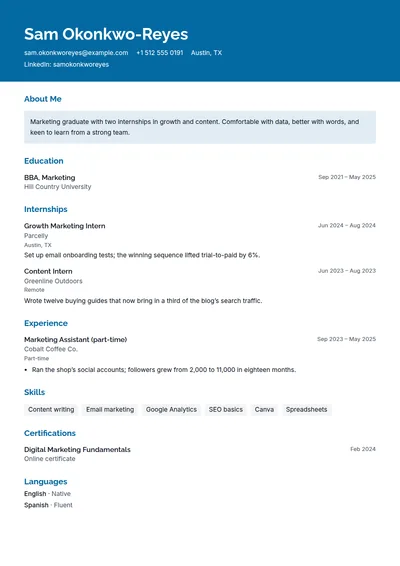
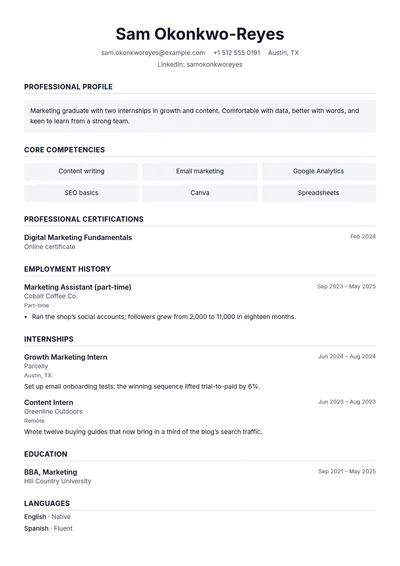
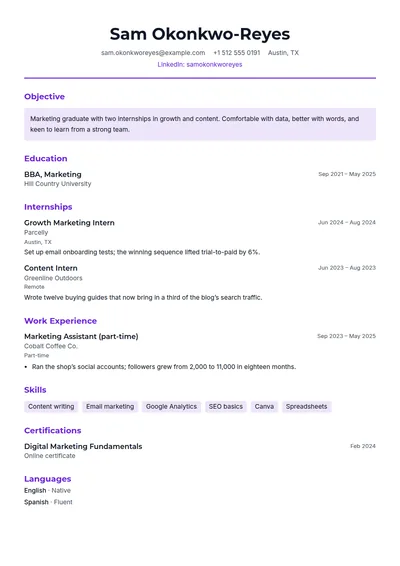
Every template exports on A4. The previews are drawn on Letter; the editor sets the page size when you export.

How the CV changes with experience

The same beginning teacher CV, written at three levels: a profile and three bullets for each.

Entry level

Zero to two years, or a first post in the title

Final-year Bachelor of Teaching student applying for a beginning teacher position from Term 1, with practicum placements in junior and middle syndicates.

  • Planned and taught a three-week maths unit on place value to a Year 4 class during my final practicum.
  • Assessed writing samples against the school's progressions and shared them with my associate teacher.
  • Ran the class's morning karakia and waiata during placement after learning them from the kaiako.

Mid level

Three to seven years, owns a process or a workload

Second-year beginning teacher close to full certification, teaching a Year 1 and 2 class and leading the school's junior reading resources.

  • Teach a new entrant and Year 1 class and plan the junior literacy programme with two colleagues.
  • Built the school's decodable reader library and trained teacher aides to use it.
  • Completed my induction programme and presented my evidence for full certification to the principal.

Senior

Eight years or more, leads people, budgets or programmes

Career changer entering teaching after ten years as an outdoor education instructor, now a beginning teacher with strong behaviour management and community links.

  • Taught children and young people on outdoor courses for ten years before retraining as a primary teacher.
  • Lead the school's education outside the classroom planning and risk assessment in my first year.
  • Bring established links with local iwi and environmental groups for inquiry learning.

Skills to put on the beginning teacher CV

Hard skills

Planning against the New Zealand Curriculum
Principals want to see that you can turn the curriculum and the school's local curriculum into weekly plans without being shown how.
Structured literacy
Most New Zealand primary schools now teach reading and spelling this way, and a beginning teacher who has used it is ready from day one.
Assessment and tracking progress
Running records, writing samples and maths assessments drive reporting to whānau and the board, and you will be asked how you use them.
Te reo Māori and tikanga
The Standards for the Teaching Profession expect it, and schools look for teachers who use te reo naturally with children and whānau.
Behaviour support
Classroom management is the area principals worry about most for a new teacher, and a calm, restorative approach is reassuring.
Digital tools such as Seesaw or Google Workspace
Schools share learning with families online, and naming the tool the school uses shows you will fit straight in.

Soft skills

Building relationships with whānau
Strong home-school connections are part of the Standards and part of how principals judge a teacher's first year.
Taking feedback well
Induction means regular observations, and schools want a beginning teacher who uses feedback rather than defends against it.
Reflective practice
Your evidence for full certification is built on reflection, and a CV that shows the habit is a good sign.
Being part of a team
Syndicates plan together, cover for each other and share duties, so fitting in matters as much as your own class.

Mistakes that cost beginning teacher interviews

  1. No certification line

    A CV that never mentions provisional certification makes a principal wonder whether you can be appointed at all. Give the certificate and the year, or the date you applied for it.

  2. Placements described in one line

    Writing only 'Practicum, Year 2, six weeks' wastes your best evidence. Say what you were responsible for and one thing you did that worked, such as a unit you planned or a group you moved forward.

  3. A teaching philosophy instead of examples

    Paragraphs about believing every child can learn tell the reader little. Show it with a child or group you helped, a strategy you used and how you knew it worked.

  4. Children named or pictured

    Never put a child's name, a photo of a class or a work sample with names on your CV or portfolio. Describe the learning instead and keep portfolio samples anonymous.

  5. Ignoring the school's character

    A large urban school, a rural school and a special character school look for different things. Read the school's charter and ERO report and mention what fits, such as a bilingual unit or a focus on outdoor learning.

Write bullets with the XYZ formula: what changed, the number that shows it, and how you did it, in one line.

Questions about the beginning teacher CV

What should a beginning teacher put on a CV in New Zealand?

Your provisional certification, your teaching degree, each practicum placement with what you taught, any relief or teacher aide work, your use of te reo Māori and tikanga, and two or three referees. Keep it to two pages.

Can I apply for teaching jobs before my certification comes through?

Yes. Many graduates apply in Term 3 and Term 4 before the certificate is issued. Write 'Provisional certification applied for' with the month so the principal knows where it stands.

Should I include relief teaching on my CV?

Yes. Even a few weeks of day relief shows you can walk into an unfamiliar class and manage it, which principals value. Give the number of days, the schools and the year levels.

How do I show te reo Māori if I am still learning?

Be specific and honest: the karakia, waiata and classroom instructions you use, any course you are taking and how you bring tikanga into routines. Schools value steady effort more than a claim of fluency.

Do I need a portfolio as a beginning teacher?

It helps. A short digital portfolio with an anonymised unit plan, an assessment you designed and a reflection from practicum gives the panel something to discuss at interview. Link it from your CV.

How do I tailor my CV to each school?

Read the advert, the school's charter and its latest ERO report, then lead with the placement or experience that matches, such as a bilingual unit or junior literacy. Paste the advert into Resume Master to get a version of your CV ordered against it, and check every example is one you can talk about.

Every application goes out fitting the vacancy.

Paste a vacancy, get a CV rewritten for it in about two minutes.

Tailor your CV — free

Free to start. No card. Same price on web, iOS and Android.