Project Engineer Resume Example

A project engineer resume is judged on the size of the jobs you have run paper and schedule for, and on whether anything slipped while you were watching it. Give the contract value, the scope and the delivery method for every project, then show how you handled submittals, RFIs, change orders and the schedule so a project manager knows exactly how much they can hand you.

The Sample resume below is for a project engineer with six years on civil and mechanical construction projects, moving from a field engineer role into running the document control and cost tracking for jobs worth up to $48M. The bullets count RFIs turned, change orders negotiated, days recovered and dollars protected, because those are the things a superintendent and an owner's rep will notice first.

Match the page to the sector in the posting. Heavy civil reads for earthwork quantities, survey control and DOT paperwork; commercial building reads for subcontractor coordination and closeout; industrial and mechanical work reads for equipment procurement, commissioning and shutdown planning. If you are aiming at the next title, the construction project manager example shows what changes at that level. The Chronological template keeps a project-by-project history easy to scan, and the engineering hub covers the design side.

Updated . The person and employers in this Sample resume are fictional.

Want a blank version to fill in? The project engineer resume template is a free Word and Google Docs file.

Project Engineer sample resume

Tyler Bransfield

Project Engineer, Civil and Mechanical Construction

Houston, TX[email protected](713) 555-0157

Summary

Project engineer with six years on civil, utility and mechanical construction projects valued from $6M to $48M, handling submittals, RFIs, change management and schedule updates for superintendents and project managers. Recovered 23 days on a water treatment expansion by resequencing the pipe gallery work around a late pump delivery. Fluent in Procore, Primavera P6 and Bluebeam, and known on site for answering an RFI before it stops a crew.

Experience

Project Engineer, Baycrest Civil Contractors

– Present

Houston, TX

  • Run document control, cost tracking and the three-week look-ahead schedule for a $48M water treatment plant expansion with 14 subcontractors on site.
  • Recovered 23 schedule days after a pump delivery slipped by resequencing the pipe gallery and yard piping work with the superintendent and two mechanical subs.
  • Processed 640 submittals and 310 RFIs over the project's first two years, keeping average RFI turnaround under five days against a contract allowance of fourteen.
  • Priced and negotiated 41 change orders worth $3.2M, including an unforeseen conditions claim the owner approved in full after the documentation was reviewed.
Field Engineer, Holloway Mechanical Contractors

–

Beaumont, TX

  • Supported two mechanical projects at a petrochemical site, tracking quantities, verifying pipe spool installation against isometrics and closing punch lists for turnover.
  • Set up the material tracking system for 2,800 pipe spools, reducing misplaced spool searches from a daily problem to a handful over the job.
  • Coordinated a 21-day plant shutdown scope with the owner's operations team, and the tie-ins finished a day and a half ahead of the outage window.
  • Wrote the daily reports and photo logs that later supported a weather delay claim worth 12 days of schedule.

Education

Bachelor of Science in Civil Engineering

Sabine Coast University, Beaumont, TX

Skills

  • Submittals and RFIs
  • Change order pricing and negotiation
  • Primavera P6 and MS Project
  • Procore and Bluebeam
  • Cost tracking and forecasting
  • Three-week look-ahead scheduling
  • Quantity tracking and takeoffs
  • Subcontractor coordination
  • Shutdown and turnaround planning
  • Quality control documentation
  • Safety planning (JHAs, pre-task plans)
  • AutoCAD and Civil 3D basics

Certifications

  • Engineer in Training (EIT), Texas Board of Professional Engineers and Land Surveyors,
  • OSHA 30-Hour Construction, OSHA Training Institute Education Center,
  • Procore Certified: Project Manager, Procore Technologies,
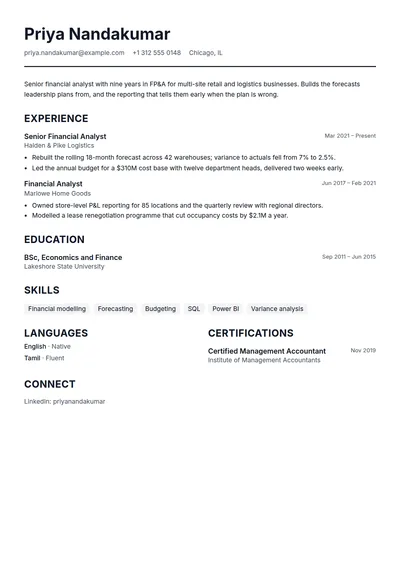
Start yours from this example

Opens this sample in the editor, in one of the templates below. Swap in your details, then tailor it to each posting in about two minutes.

Use this example

Already have a project engineer resume? Check it against a posting

Paste your resume and the posting you want. The keyword match, the terms you are missing and the biggest fix show here as you type, in your browser. Nothing is sent until you ask for the version written for that posting.

Check your fit — free, no account

Worked out in your browser as you type. Nothing is sent.

Result

A staff nurse's resume against a charge nurse posting. Paste yours to see your own.

33%

13 of the posting's 40 terms are on this resume.

Missing
  • coordinate
  • shift
  • staffing

Biggest fix: 2 bullets open with a duty, not a result.

A keyword match, not a verdict from any applicant tracking system.

Templates for the project engineer resume

All templates

How to write a project engineer resume

  1. Say which kind of project engineer you are

    The title means different jobs in construction, plant operations and product development, and recruiters filter on the difference. Settle it in the headline: Project Engineer, Commercial Building Construction or Project Engineer, Industrial and Mechanical, EIT. If you have field engineer or superintendent experience, the headline can carry it, because general contractors value people who have walked the job. Put your EIT or PE status next to the title when you hold one, and the platforms you run projects in when the posting names them. Keep the contact line to a phone, an email, a city and whether you can relocate or travel to job sites, since many contractors staff projects in other cities.

  2. Lead the summary with project size and delivery method

    A project manager reading your summary wants to know how big a job you can keep the paper moving on. Give the range of contract values, the sectors and the delivery methods you have worked under. Project engineer with five years on design-build and CM-at-risk projects from $10M to $65M, in healthcare and higher education. The second sentence gives one schedule or cost result you can stand behind; the third gives the software and credentials. Delivery method matters more than many engineers realize: a firm that does mostly design-build wants to see you have worked alongside designers during preconstruction, while a hard-bid contractor wants to see you protected margin on change orders.

  3. List projects, not just employers

    Readers in construction think project by project, so under each employer give each major project its own line: the project type, the value, the owner type and your role. Two-story medical office building, $22M, private healthcare owner, project engineer from foundations through closeout. Then write two or three bullets for that project with counts and outcomes: submittals logged, RFIs and their turnaround, change orders priced and approved, days recovered, punch items closed before turnover. If you supported several small projects at once, group them into one line with the combined value and the number of jobs. Projects still under way are fine; mark them ongoing and report what has happened so far.

  4. Connect every document to schedule or money

    Submittals, RFIs, daily reports and meeting minutes are only interesting on a resume when they show what they protected. End each bullet with the effect: the crew that did not stop, the claim that held up, the margin that stayed in the job. Caught a duct and sprinkler main clash in the coordination model before rough-in, avoiding an estimated week of rework on the third floor. When you write about change orders, give the count and the total value, and say whether you priced them, negotiated them or both. A hiring manager reads that line as evidence you can be trusted with the commercial side of a project, which is the step toward project manager.

  5. Name your software, licenses and safety training

    Put the tools you work in where an applicant tracking system will find them: scheduling software such as Primavera P6 or MS Project, a construction management platform, a PDF markup tool, and any estimating or modeling software you use for takeoffs and clash detection. Under certifications, list your EIT or PE with the issuing state board, an OSHA 30 card, and any first aid or site-specific safety training. Many contractors also value a LEED credential on building projects and a concrete or soils testing certificate on civil work. Give each with the year. If you are working toward the PE exam, say when you plan to sit for it; firms that sponsor engineers like to see the plan.

  6. Show the path toward project management

    Most project engineers are hired with an eye on who will run projects in three to five years, so the resume should show responsibility growing. Order bullets in each job from routine work to the work that a project manager would normally own: an owner meeting you ran, a buyout you handled, a subcontractor you managed through a dispute, a forecast you built for the monthly cost report. If you have mentored field engineers or interns, say how many. The construction project manager example shows what that next page reads like, and the civil engineer example covers the design side if you are weighing a move into an engineering firm.

Project Engineer resume summary examples

Three sentences at the top of the page, written for where you are now.

New graduate with internships

Construction management graduate with two summers as a project engineering intern on K-12 school projects worth $18M and $31M. Logged submittals, drafted RFIs and walked punch lists with the superintendent. Holds an OSHA 30 card and is ready to support a project team full time.

Field engineer moving into the office side

Field engineer with three years on heavy civil projects, laying out work, tracking quantities and checking installation against the drawings. Wrote the daily reports and photo logs used in two delay claims. Looking for a project engineer role that adds cost tracking, change orders and scheduling.

Manufacturing project engineer

Project engineer with six years running capital projects in food and beverage plants, from equipment specification through installation and startup. Delivered a second packaging line under a $4.1M budget and two weeks early, raising plant capacity by a third. Experienced with vendor contracts, sanitary design standards and validation protocols.

Senior project engineer ready for a PM title

Senior project engineer with eight years at a general contractor, currently running the commercial side of a $90M hospital addition with two project engineers reporting in. Owns the monthly cost report, the change order log and owner meetings for the mechanical and electrical scope. Licensed PE seeking a project manager role.

How the resume changes with experience

The same project engineer resume, written at three levels: a summary and three bullets for each.

Entry level

Zero to two years, or a first role in the title

Civil engineering graduate with two construction internships and an EIT, ready to take on submittals, quantities and daily reports on an active job site.

  • Tracked earthwork and concrete quantities on a $9M roadway job during a summer internship, reconciling them with pay applications each month.
  • Logged and distributed 120 submittals in the project's document system with no missed review dates.
  • Flagged a rebar spacing conflict in the shop drawings before the pour, avoiding a rework day for the concrete crew.

Mid level

Three to seven years, owns a process or a workload

Project engineer with four years on commercial building projects, owning RFIs, submittals, change orders and the schedule updates the project manager relies on.

  • Handle document control and cost reports for two concurrent projects worth $30M combined.
  • Closed out a $14M office fit-out with all punch items resolved two weeks before the tenant move-in.
  • Rejected a subcontractor's change request after tracing the scope to their original bid documents, saving the owner roughly $90,000.

Senior

Eight years or more, leads people, budgets or programs

Senior project engineer with nine years across heavy civil and industrial work, mentoring field engineers and running the commercial side of large projects while stepping into project management.

  • Lead the project engineering team of four on a $120M highway interchange with a state DOT owner.
  • Managed the change order log to a net positive margin on a job where the estimate had missed a major utility relocation.
  • Recommended against accelerating a bridge deck pour under a heat forecast, and the owner later credited the decision after a neighboring project cracked its deck.

More project engineer resume bullet points

Pick the ones that are true for you, then put your own numbers in.

Documents and coordination

  • Built the submittal register for a $27M laboratory building from the specifications, flagging 35 long-lead items before buyout was finished.
  • Ran weekly MEP coordination meetings with five trades and the design team, closing 140 model clashes before ceilings were installed.
  • Wrote and tracked meeting minutes for owner, architect and contractor meetings, with every open item assigned an owner and a due date.
  • Cut RFI response time from about twelve days to six by sorting questions by urgency and walking the critical ones to the architect in person.

Schedule and cost

  • Updated the baseline schedule monthly in P6 and reported float on the critical path to the owner's representative.
  • Built the cost-to-complete forecast for three projects, which the project manager used in every monthly report to the operations director.
  • Negotiated a subcontractor's change request from $310,000 down to $185,000 by tracing the scope back to their bid clarifications.
  • Tracked owner-furnished equipment deliveries against the schedule and moved two installations forward when early deliveries arrived.

Quality, safety and closeout

  • Organized third-party inspections for concrete, steel and fireproofing, with every report filed and linked to the right drawing area.
  • Wrote pre-task plans with crews on a site that finished 180,000 work hours without a lost-time incident.
  • Assembled closeout documents, warranties and as-builts for a $16M school in four weeks, so the contractor's final payment was released on time.
  • Walked punch lists with the architect and closed 420 items before the owner's move-in date.

Skills to put on the project engineer resume

Hard skills

Submittal and RFI management
These are the daily work of the job, and turnaround times you can quote prove you keep crews moving.
Change order pricing
Protecting the contract margin is what separates a project engineer who is trusted with money from one who is not.
Scheduling (P6 or MS Project)
Owners require baseline and updated schedules, and reading a critical path is a common interview test.
Cost tracking and forecasting
Project managers want to know the job's cost-to-complete every month, and they hire engineers who can build that number.
Construction software (Procore, Bluebeam)
Most general contractors run on one of a few platforms, and certification on it shortens your ramp-up.
Plan reading and takeoffs
Catching a conflict in the drawings before it reaches the field is worth more than any report you can write afterward.
Safety documentation
Pre-task plans and JHAs are your responsibility on many sites, and an OSHA 30 card is often a hiring requirement.

Soft skills

Follow-through
An RFI that sits for a week stops a crew, and superintendents will tell the hiring manager whether you close the loop.
Diplomacy with subcontractors
You will deliver bad news about schedule and scope weekly, and keeping those relationships working is a skill managers test for.
Composure on site
Deliveries slip and weather turns, and the person tracking the plan needs to stay calm while it is rebuilt.
Written clarity
Daily reports and change narratives become claim evidence later, and sloppy writing costs the company real money.

Keywords from project engineer job postings

Use the ones you can back up with a bullet. Paste the posting into the free resume keyword checker to see which of its terms your resume is missing.

  • project engineer
  • submittals
  • RFIs
  • change orders
  • cost tracking
  • cost-to-complete forecast
  • Primavera P6
  • MS Project
  • Procore
  • Bluebeam
  • three-week look-ahead
  • subcontractor coordination
  • MEP coordination
  • clash detection
  • quantity takeoffs
  • daily reports
  • punch lists
  • closeout documents
  • quality control
  • OSHA 30
  • EIT
  • design-build
  • capital projects
  • commissioning

Mistakes that cost project engineer interviews

  1. Projects without a dollar value

    Contract value is the fastest way a reader sizes you up. Put it in the first line of every project, along with the delivery method and the owner type, such as a $48M design-bid-build for a municipal utility.

  2. Duties in place of counts

    Managed RFIs and submittals is a job description. Say how many you processed, the turnaround you held, and how many change orders you priced and for how much.

  3. No connection to schedule or cost

    Everything a project engineer does should protect the schedule or the budget. End your bullets with the days recovered, the claim supported, the margin protected or the closeout finished early.

  4. Forgetting the field years

    Time as a field engineer, intern or laborer is a strength. It shows you understand how the work gets built, which project managers value in the person tracking it.

  5. Generic software claims

    Name the platforms the posting names, and say what you did in them: built the look-ahead in P6, ran the submittal log in Procore, redlined drawings in Bluebeam.

Write bullets with the XYZ formula: what changed, the number that shows it, and how you did it, in one line.

Questions about the project engineer resume

Is a project engineer the same as a project manager?

No. A project engineer supports the project manager and superintendent with documents, cost tracking, scheduling and coordination. It is the usual path to project management, so show ownership growing over time.

Should I list projects individually on a project engineer resume?

Yes. Under each employer, name the project, its value and your role, then two or three result bullets. Readers in construction think in projects, not job titles.

Do I need an engineering degree to be a project engineer?

Most general contractors expect a degree in civil engineering, construction management or a related field. Strong field experience plus a construction management certificate can substitute at some firms.

Which certifications help a project engineer?

An EIT, an OSHA 30 card and certification on the contractor's software platform are the common ones. A PMP or CCM matters more once you move toward project management.

How do I show results when the project is still under way?

Report what has happened so far: submittals processed, RFI turnaround, schedule variance to date, change orders approved. Mark the project as ongoing with its expected completion date.

Is a manufacturing project engineer resume written the same way?

The structure is the same, but the vocabulary changes. In a plant, a project engineer runs capital projects such as a new line, an equipment upgrade or a facility expansion, so the bullets cover capital requests, vendor selection, installation, validation and startup, and results are measured in throughput, downtime, yield and payback rather than RFIs and change orders. Name the industry and the regulatory frame, such as FDA-regulated or automotive quality standards, near the top.

Every application goes out fitting the job.

Paste a posting, get a resume written for it in two minutes.

Tailor your resume — free

Free to start. No card. Same price on web, iOS and Android.