Aged Care Worker CV Example (Australia)

Care managers at Australian aged care providers shortlist an Aged Care Worker on three things before anything else: the Certificate III in Individual Support, current screening checks, and evidence that residents and clients are safe and treated with dignity in your hands. Put the qualification, the National Police Check and the NDIS Worker Screening Check near the top, then show the setting you work in and what a shift looks like.

The Sample CV below is for a personal care worker with five years across a residential home and a home care package provider on the Central Coast of New South Wales. Her bullets cover personal care, dementia support, manual handling with hoists, progress notes and the small changes that matter to residents, such as fewer falls on her wing and families who ask for her by name.

Tailor it to the setting in each advert. A residential home wants shift work, dementia and palliative care; a home care provider wants a driver's licence, your own car and the confidence to work alone; a community program wants social support and outings. The US counterpart of this page is the caregiver resume example, written for American home care agencies; the Civic template keeps an aged care CV plain enough for provider job portals.

Updated . The person and employers in this Sample CV are fictional. Written for applicants in Australia; the page for applicants in the US is the caregiver resume example.

Aged Care Worker sample CV

Drawn at A4 proportions, the paper an Australian CV is printed on.

Rosalind Ebbington

Personal Care Worker, Certificate III in Individual Support (Ageing), residential and home care

Gosford, NSWrosalind.ebbington@example.com0491 572 318

Summary

Personal care worker with five years in residential aged care and home care packages, supporting residents living with dementia, frailty and chronic illness on a 40-bed memory support wing and in their own homes. Known for calm, unhurried personal care, careful progress notes and noticing early when a resident is not themselves. Holds a current police check, NDIS Worker Screening clearance, first aid and a full driver's licence with a reliable car.

Experience

Personal Care Worker, Memory Support Wing, Banksia Terrace Residential Care

– Present

Gosford, NSW

  • Provide personal care, showering, continence care, meals and mobility support for eight to ten residents per shift on a secure 40-bed wing for people living with dementia, across mornings, afternoons and weekends.
  • Use hoists, slide sheets and standing aids for every transfer in line with each resident's mobility plan; my wing recorded its fewest falls in two years after we added a mid-afternoon walk and toileting round I suggested.
  • Write progress notes in the electronic care system each shift and report changes in skin, appetite, mood or behaviour to the registered nurse, so concerns are picked up before they become a hospital transfer.
  • Support residents and families through palliative care, providing mouth care, repositioning and company, and buddy new staff through their first two weeks on the wing.
Home Care Worker, Home Care Packages, Coral Fern Home Care

–

Wyong, NSW

  • Visited up to seven older clients a day in their homes for personal care, medication prompts, domestic assistance and shopping, working alone and to a tight schedule.
  • Kept clients' care plans current by flagging changes to the care coordinator, including a client whose falls led to a reassessment and a higher package level.
  • Drove clients to appointments and social outings in my own car under the provider's transport policy, with a clean record across two years of visits.

Education

Certificate III in Individual Support (Ageing)

Brisbane Water Community College, Gosford, NSW

120 hours of work placement in residential aged care.

Skills

  • Personal care and continence care
  • Dementia support and redirection
  • Manual handling, hoists and slide sheets
  • Progress notes and incident reporting
  • Medication prompting and assistance
  • Palliative care support
  • Infection prevention and control
  • Meal assistance and texture-modified diets
  • Social support and outings
  • Working alone in clients' homes

Certifications

  • National Police Check, NSW Police Force,
  • NDIS Worker Screening Check (cleared), NSW Office of the Children's Guardian,
  • Provide First Aid (HLTAID011), Nationally recognised training provider,
  • Full NSW driver's licence, own comprehensively insured car, Transport for NSW,
Start yours from this example

Opens this sample in the editor, in one of the templates below. Swap in your details, then tailor it to each vacancy in about two minutes.

Use this example

How an Australian CV differs

An aged care CV in Australia is shaped by regulation more than an American caregiver page. Providers are accredited against the Aged Care Quality Standards, every worker needs a current National Police Check, and many providers now ask for the NDIS Worker Screening Check as well, so the checks are part of the CV, not an afterthought. The job title varies by provider: personal care worker, Assistant in Nursing, care service employee or simply carer. Use the one in the advert alongside your own, and keep the CV to two pages of A4 with two referees at the end.

For a aged care worker in Australia

  1. The Certificate III first

    Most providers require a Certificate III in Individual Support, with the Ageing or Home and Community specialisation, or are happy to hire while you finish it. Name the qualification, the training organisation, the year and your placement hours in the education section.

  2. Checks, with the year

    List the National Police Check, the NDIS Worker Screening Check if you hold one, first aid and your flu and COVID-19 vaccinations, each with the year. A care manager can then see you are ready to start without a wait.

  3. Residential or home care

    Say which setting each role was in. Residential work is shifts and a team on the floor; home care packages mean driving between clients, working alone and keeping to a schedule, so mention your licence and car for those roles.

  4. Quality Standards in plain words

    You do not need to quote the Standards, but bullets about dignity and choice, safe personal care, reporting incidents and supporting palliative residents show an assessor-ready worker. Serious incidents are reported under the Serious Incident Response Scheme; knowing that is worth a line.

  5. Availability on the CV

    Aged care rosters are the hardest part to fill. State the shifts you can work, such as mornings, afternoons, nights and weekends, and whether you want permanent part-time or casual hours.

Every CV in Australia

A4 paper
Australia prints on A4. A Letter-sized PDF prints short on A4 and tells a recruiter the CV came from a US template.
Two to three pages
Australian CVs run longer than UK ones: two pages is normal and three is accepted for experienced applicants. One page suits a first job.
No photo
No photo, date of birth or marital status. Australian employers do not expect them, and anti-discrimination law makes most prefer not to see them.
Dates as DD/MM/YYYY
Day first where a full date appears, month and year for each role. The US month-first order reads wrong to an Australian recruiter.
Australian English
Australian English follows British spelling: organise, programme, centre, licence, specialise.
Suburb and state, not a street address
"Parramatta, NSW" is enough on the contact line. A full address is not expected, and the US-style ZIP line never is.

More on applying in Australia, with every CV example for it, on the Australia page.

Templates for the aged care worker CV

All templates

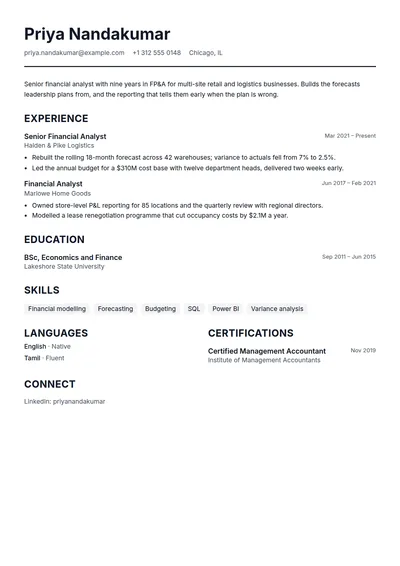
Every template exports on A4. The previews are drawn on Letter; the editor sets the page size when you export.

How the CV changes with experience

The same aged care worker CV, written at three levels: a profile and three bullets for each.

Entry level

Zero to two years, or a first post in the title

Newly qualified carer with a Certificate III in Individual Support (Ageing) and 120 hours of placement in a residential home, looking for a first role in aged care. No paid care experience yet, but years of looking after a grandparent at home and a calm, patient manner with older people.

  • Completed a 120-hour placement on a residential wing, assisting with showering, dressing and meals for up to six residents under a senior carer's supervision.
  • Cared for my grandmother at home for two years, managing her medication reminders, appointments and mobility around the house.
  • Worked weekends at a café for three years, showing reliability on a roster, food handling skills and an easy way with customers of every age.

Mid level

Three to seven years, owns a process or a workload

Assistant in Nursing with four years in a private residential home, rostered across day and night shifts on a 60-bed general wing.

  • Care for up to twelve residents on a night shift, completing two-hourly checks, repositioning and continence care with a second carer.
  • Trained as the wing's infection control champion during outbreaks, setting up PPE stations and teaching donning and doffing to new staff.
  • Run the weekly lifestyle session on the wing, from music and reminiscence to hand massage, planned with the lifestyle coordinator.

Senior

Eight years or more, leads people, budgets or programmes

Care Team Leader with ten years in aged care, leading a shift of eight carers in a 90-bed home and acting as the link between carers and the registered nurse.

  • Allocate residents, breaks and tasks for a team of eight personal care workers per shift and step in on the floor when the wing is short.
  • Audit progress notes, falls and pressure area care each month as part of the home's quality program for the Aged Care Quality Standards.
  • Induct and mentor new carers and Certificate III students on placement, signing off their competencies with the clinical educator.

Skills to put on the aged care worker CV

Hard skills

Personal care with dignity
Showering, dressing and continence care are most of the shift, and a care manager wants to know you do them gently and with the resident's choices respected.
Dementia support
Most residential homes have a memory support area, and carers who can redirect, reassure and spot distress are the ones rostered there.
Manual handling and equipment
Hoists, slide sheets and standing aids are used on every shift, and safe transfers protect both the resident and your own back.
Progress notes and reporting
What you write in the care system is the evidence an assessor reads, so clear, factual notes show you understand the Quality Standards in practice.

Soft skills

Patience
Residents living with dementia need time, and a carer who never rushes a shower or a meal makes the whole wing calmer.
Observation
Noticing that a resident is quieter, eating less or newly confused is often the first sign of an infection or a fall risk.
Reliability
Aged care runs every day of the year, and a carer who turns up for weekends, nights and public holidays is valued above almost anything else.

Mistakes that cost aged care worker interviews

  1. Missing or out-of-date checks

    A CV with no police check, or one from five years ago, gets put aside because the provider cannot roster you. Give the year of each check and say you will renew it if needed.

  2. Writing only 'provided care'

    Every carer provides care. Say how many residents, what kind of wing, which equipment and which shifts, so the care manager can picture you on the floor.

  3. Hiding the qualification

    If the Certificate III is at the bottom of page two, a quick screen may miss it. Put it in the headline and the education section, with the specialisation.

  4. No mention of availability

    A provider hiring for weekends and nights needs to know you can work them. Leaving availability out means a phone call you may never get.

  5. Copying an American caregiver page

    A one-page document about private-duty caregiving, written with US spelling, does not match Australian providers. Use the local title, the Certificate III, the checks and two pages of A4.

Write bullets with the XYZ formula: what changed, the number that shows it, and how you did it, in one line.

Questions about the aged care worker CV

How do I write an aged care CV with no experience?

Lead with the Certificate III and the placement hours, describe what you did on placement in bullets, then add any caring you have done for family and jobs that show reliability on a roster, such as hospitality or retail. Put your checks and availability on the first page.

Do I need a Certificate III to work in aged care?

Most providers ask for a Certificate III in Individual Support or are willing to hire you while you complete one. If you are still studying, write the expected completion month and the placement you have done so far.

Which checks should be on an aged care worker CV?

A current National Police Check, the NDIS Worker Screening Check if you have it, a first aid certificate, and your vaccinations. Add a driver's licence and car if you are applying for home care roles.

What is the difference between a personal care worker and an AIN?

The duties overlap a great deal and providers use the titles differently. AIN is more common in New South Wales and hospitals, personal care worker in residential homes and other states. Use the title from the advert and explain your actual duties in the bullets.

How long should an aged care CV be?

Two pages of A4 is right for most carers, with the headline, checks, current role and qualification on page one. A new carer may fit everything on one page, which is fine.

Should I tailor my CV for residential and home care jobs?

Yes. Residential roles want shift work, dementia and team skills; home care roles want independence, driving and time management. Paste each advert into Resume Master and it reorders and rewrites your CV around what that provider asks for.

Every application goes out fitting the vacancy.

Paste a vacancy, get a CV rewritten for it in about two minutes.

Tailor your CV — free

Free to start. No card. Same price on web, iOS and Android.