Registered Nurse CV Example (Australia)

Nurse Unit Managers and health service recruiters in Australia read a Registered Nurse CV in a fixed order: AHPRA registration, the ward and the patient group, then evidence of safe, skilled care. Put your AHPRA registration and your classification (RN Year 6, Clinical Nurse Specialist) where they are seen first, name the ward and the hospital type for every role, and give the patient load and acuity you carry on a shift.

The Sample CV below is for a Registered Nurse with six years on acute surgical and orthopaedic wards at a public hospital and a private hospital in western Sydney. Its bullets pair clinical work with the measures a NUM is held to: falls, pressure injuries, discharge before 10 am, hand hygiene audits, plus precepting graduates and running the ward in charge.

Tailor it to each vacancy and its selection criteria. A public hospital role on a state health careers site wants a statement against each criterion; a private hospital wants elective pathways and patient experience; an aged care provider wants the Aged Care Quality Standards; a remote area post wants independence and emergency skills. Match the hospital's electronic record, since most adverts name Cerner or Epic. The US counterpart of this page is the registered nurse resume example, written for American hospitals on Letter paper; the Civic template keeps the CV plain for public health recruitment portals.

Updated . The person and employers in this Sample CV are fictional. Written for applicants in Australia; the page for applicants in the US is the registered nurse resume example.

Registered Nurse sample CV

Drawn at A4 proportions, the paper an Australian CV is printed on.

Lauren Tavendale

Registered Nurse, AHPRA registered, RN Year 6, Surgical and Orthopaedics

Penrith, NSWlauren.tavendale@example.com0491 570 112

Summary

Registered Nurse with six years on acute surgical and orthopaedic wards, caring for four to five post-operative patients per shift on a 30-bed ward with a joint replacement pathway. Co-led the ward's pressure injury work that brought hospital-acquired injuries to their lowest level in three years, precept graduate nurses through their rotations, and take the in-charge shift two or three times a fortnight. Steady with a deteriorating patient and clear with families.

Experience

Registered Nurse, Orthopaedic and Surgical Ward (RN Year 6), Blaxland Ridge Hospital

– Present

Penrith, NSW

  • Care for four to five acute surgical and orthopaedic patients per shift, including joint replacements on an enhanced recovery pathway, epidurals and PCA, and post-operative deterioration.
  • Co-led the ward's pressure injury group, introducing a two-hourly repositioning round and a skin check at admission; hospital-acquired pressure injuries fell to their lowest level in three years.
  • Precept graduate nurses on the surgical rotation of the transition program; all eight I have precepted completed the rotation and three stayed on the ward.
  • Take the in-charge shift two or three times a fortnight, allocating staff, working with the bed manager on admissions and escalating through the Between the Flags criteria to the rapid response team.
Registered Nurse, Day Surgery and Surgical Ward, St Finbar's Private Hospital

–

Parramatta, NSW

  • Cared for up to six elective surgical patients per shift across general surgery, urology and gynaecology on a 24-bed ward, with same-day discharge for day cases.
  • Wrote the ward's discharge checklist for day surgery patients, adopted across the hospital and credited by the NUM with fewer post-discharge phone queries.
  • Completed the hospital's graduate nurse program in my first year and joined the deteriorating patient committee, auditing observation charts monthly.

Education

Bachelor of Nursing

University of Western Plains, Kingswood, NSW

Clinical placements in acute surgery, medicine, mental health, community and aged care.

Skills

  • Post-operative and orthopaedic care
  • Deteriorating patient recognition (Between the Flags)
  • Medication administration and IV therapy
  • Pain management, epidurals and PCA
  • Wound and pressure injury care
  • Discharge planning
  • Cerner eMR
  • In charge of shift
  • Precepting graduate nurses
  • Hand hygiene and infection control

Certifications

  • AHPRA registration, Registered Nurse (Division 1), no conditions, number on request, Nursing and Midwifery Board of Australia,
  • Advanced Life Support, Australian Resuscitation Council accredited provider,
  • Working with Children Check (NSW), Office of the Children's Guardian,
Start yours from this example

Opens this sample in the editor, in one of the templates below. Swap in your details, then tailor it to each vacancy in about two minutes.

Use this example

How an Australian CV differs

An Australian nursing CV is longer and more formal than a UK one and quite different from the American one. Registration is with AHPRA under the Nursing and Midwifery Board of Australia, shown as a registration number and a division, not a state licence; the title is Registered Nurse with an award classification, then Clinical Nurse Specialist or Nurse Unit Manager; and the ward sits inside a Local Health District, a hospital and health service, or a private operator. Public hospital applications still ask for a statement against selection criteria, and the CV runs to two or three pages of A4 with referees listed at the end, usually your current NUM and a previous one.

For a registered nurse in Australia

  1. AHPRA registration and division

    Write Registered Nurse (Division 1), the registration year and no conditions, and give the number on request. Enrolled Nurses are Division 2 and a different post, so say which you are.

  2. Classification, not band

    Give your year level under the state award (RN Year 6) and any Clinical Nurse Specialist or Clinical Nurse Consultant classification. The recruiter uses it to place you on the pay scale.

  3. Selection criteria and the cover letter

    State health services ask you to address selection criteria such as demonstrated ability to work in a team or commitment to quality improvement. Write your CV bullets as full sentences with a situation, an action and a result so they lift straight into those answers.

  4. Referees listed, not withheld

    Australian employers expect two referees named on the CV, with role and phone, usually your current NUM and a previous manager. Ask them first; the hospital will ring before an offer.

  5. Pre-employment checks and immunisations

    A National Police Check, a Working with Children Check and an immunisation record are required before you start. List the ones you hold with the year so the recruiter can tick them off.

  6. Graduate and transition programs

    A graduate nurse names the transition to practice program and its rotations. An experienced nurse who precepts graduates says so; health services value it.

Every CV in Australia

A4 paper
Australia prints on A4. A Letter-sized PDF prints short on A4 and tells a recruiter the CV came from a US template.
Two to three pages
Australian CVs run longer than UK ones: two pages is normal and three is accepted for experienced applicants. One page suits a first job.
No photo
No photo, date of birth or marital status. Australian employers do not expect them, and anti-discrimination law makes most prefer not to see them.
Dates as DD/MM/YYYY
Day first where a full date appears, month and year for each role. The US month-first order reads wrong to an Australian recruiter.
Australian English
Australian English follows British spelling: organise, programme, centre, licence, specialise.
Suburb and state, not a street address
"Parramatta, NSW" is enough on the contact line. A full address is not expected, and the US-style ZIP line never is.

More on applying in Australia, with every CV example for it, on the Australia page.

Templates for the registered nurse CV

All templates

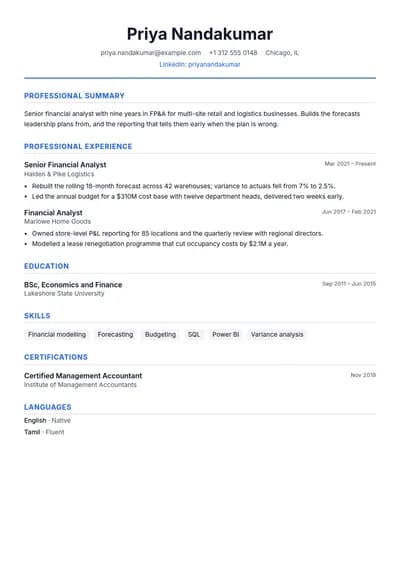
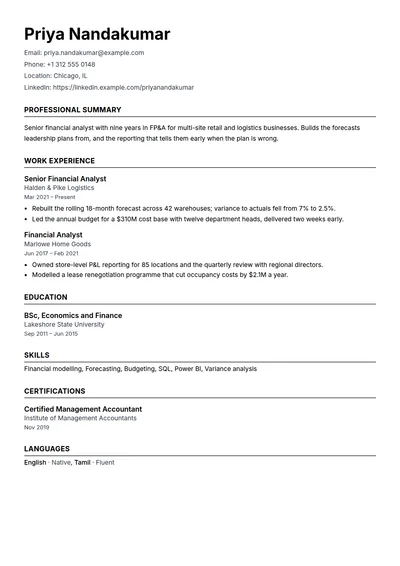
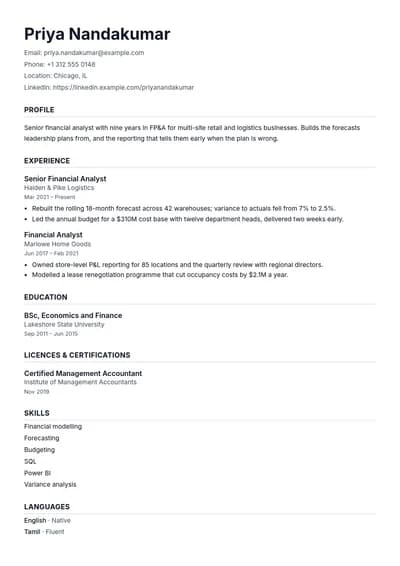
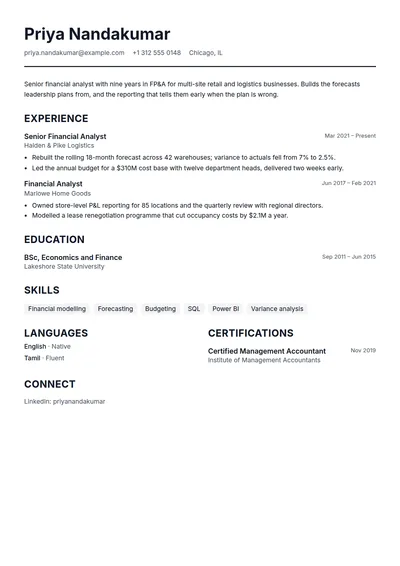
Every template exports on A4. The previews are drawn on Letter; the editor sets the page size when you export.

How the CV changes with experience

The same registered nurse CV, written at three levels: a profile and three bullets for each.

Entry level

Zero to two years, or a first post in the title

Graduate Registered Nurse with a Bachelor of Nursing and a final placement on an acute medical ward, AHPRA registered and accepted into a transition to practice program. Ready to learn from an experienced ward team.

  • Completed a 160-hour final placement caring for up to four medical patients under a preceptor, including admissions and discharges.
  • Delivered discharge teaching to patients and carers using teach-back, signed off by the clinical nurse educator.
  • Worked as an Assistant in Nursing in an aged care home for two years during the degree, building confident personal care and observations.

Mid level

Three to seven years, owns a process or a workload

Registered Nurse with four years in a busy Brisbane emergency department, confident with triage, resuscitation and fast-moving shifts.

  • Triage up to 60 presentations per shift on the Australasian Triage Scale and care for patients across the acute and fast-track areas.
  • Sit on the department's practice council and helped rewrite the sepsis pathway.
  • Supervise and assess nursing students on their emergency placement.

Senior

Eight years or more, leads people, budgets or programmes

Nurse Unit Manager with twelve years of clinical and leadership experience, accountable for staffing, quality and the budget of a 32-bed medical ward.

  • Manage a team of 46 nurses and assistants in nursing with responsibility for rostering, performance and a ward budget of A$5.2 million.
  • Reduced agency and overtime spend through a revised roster and a retention plan for graduates.
  • Lead the ward's quality program, including falls, pressure injuries and infection control audits for accreditation under the NSQHS Standards.

Skills to put on the registered nurse CV

Hard skills

Patient assessment and the deteriorating patient
Every Australian hospital escalates on a track-and-trigger chart, and a nurse who assesses well and escalates early is trusted with the sickest patients.
Medication administration and IV therapy
Safe administration is the baseline; IV competencies, controlled drugs and specialist infusions show you can take the higher-acuity patients.
Specialty skills such as orthopaedics, telemetry or triage
Wards recruit for specific skills, and naming yours matches you to the vacancy a health service is actually trying to fill.
Electronic medical records
Health services name Cerner, Epic or their own eMR in the advert, and experience with it shortens your supernumerary shifts.
Discharge planning
Discharge before 10 am is measured on most wards, and a nurse who moves patients safely home is valued across the hospital.
Mandatory training in date
ALS or BLS, hand hygiene, manual handling and child safety are checked at interview, and listing them with the year shows you can start without a backlog.

Soft skills

Calm under pressure
A MET call on a short-staffed shift happens on every ward, and the panel wants to hear how you kept the bay safe.
Compassion
Patient experience surveys go to the NUM every month, and families remember who explained things to them.
Teamwork and handover
A ward runs on bedside handover, and the nurse who hands over clearly keeps the next shift out of trouble.

Mistakes that cost registered nurse interviews

  1. AHPRA registration buried

    A nurse recruiter checks the register before anything else. Put Registered Nurse (Division 1) and AHPRA registered in the headline and the registration year in a registration and training section near the top.

  2. No ward, classification or patient load

    Registered Nurse says little by itself. Name the ward, the specialty, the bed numbers, your year level and the patients you take per shift, so the NUM can picture you on the roster.

  3. Ignoring the selection criteria

    A CV sent without a statement against the criteria goes to the bottom of a public hospital pile. Write the statement, and make the CV bullets the evidence it points to.

  4. Leaving out the electronic record

    Health services name Cerner, Epic or their own eMR. Name the ones you have used so the shortlisting screen matches them.

  5. A one-page CV in the American style

    A single page with a state licence, a US-style address line and American spelling reads as written for somewhere else. Use two to three pages, AHPRA, Australian spelling and the titles in the advert.

Questions about the registered nurse CV

Where do I put my AHPRA registration number on a CV?

Write Registered Nurse (Division 1), AHPRA registered in the headline and give the registration year and conditions, if any, in a registration section near the top. Put the number on request on a CV you upload to a jobs site.

How long should a Registered Nurse CV be in Australia?

Two to three pages of A4. A graduate fits two; a Clinical Nurse Consultant or NUM with several wards and quality work may need three, but keep the registration and the current ward on the first page.

Do I have to address the selection criteria?

Yes, for public health services, and often for the private operators too. Write one or two paragraphs for each criterion with a specific example, and keep the CV bullets as the evidence behind them.

What should a graduate nurse put on a CV?

Your degree and university, your AHPRA registration date, your placements with the ward type and hours, your final placement in detail, any Assistant in Nursing work, and the transition program you are applying to or have completed.

What is the difference between an EN and an RN on a CV?

An Enrolled Nurse holds a Diploma of Nursing and registers in Division 2, working under the supervision of a Registered Nurse. An RN holds a Bachelor of Nursing and registers in Division 1. Say which you are and, if you are an EN upgrading, where you are in the degree.

How do I tailor a nursing CV to a new specialty or a new state?

Lead with the transferable skills the new ward's criteria ask for, add the relevant competencies, and note that AHPRA registration is national so no new licence is needed across states. Paste the advert into Resume Master and it rewrites the CV against it in about two minutes.

Every application goes out fitting the vacancy.

Paste a vacancy, get a CV rewritten for it in about two minutes.

Tailor your CV — free

Free to start. No card. Same price on web, iOS and Android.