Graduate Registered Nurse CV Example (Australia)

A graduate nurse CV in Australia is read by a panel of nurse educators who are choosing people for a transition to practice program, not hiring a finished clinician. They want to see your clinical placements with the ward type and hours, how you reflected on them, your AHPRA application timing, and any paid work in health that shows you can already hold your own on a shift.

The Sample CV below is for a final-year Bachelor of Nursing student in regional Victoria applying to graduate programs across several health services. It leads with placements rather than employment, turns each placement into evidence of the skills a graduate is expected to have, and uses her Assistant in Nursing job to show shift work, teamwork and confidence with patients before registration.

This is a different document from an experienced nurse's CV. An experienced Registered Nurse leads with a ward, a classification and a patient load; a graduate leads with training, placements and potential, and is usually submitted through a statewide graduate recruitment round with preferences for health services and rotations. The US counterpart of this page is the nursing student resume example, written for American new-grad residency programs; the Campus template suits a CV led by education and placements.

Updated . The person and employers in this Sample CV are fictional. Written for applicants in Australia; the page for applicants in the US is the nursing student resume example.

Graduate Registered Nurse sample CV

Drawn at A4 proportions, the paper an Australian CV is printed on.

Tahlia Ferncroft

Graduate Registered Nurse, Bachelor of Nursing (completing 2026), AHPRA application lodged

Ballarat, VICtahlia.ferncroft@example.com0491 575 064

Summary

Final-year Bachelor of Nursing student with 840 hours of clinical placement across acute medical, surgical, mental health, community and aged care settings, completing the degree in November 2026. Worked as an Assistant in Nursing on a rehabilitation ward for eighteen months during the degree, which taught me handover, prioritising and caring for patients through long admissions. Applying for a graduate program with rotations in medicine and surgery, with an interest in post-operative care.

Experience

Assistant in Nursing (casual), Rehabilitation Ward, Lakeview Gardens Private Hospital

– Present

Ballarat, VIC

  • Assist registered nurses with hygiene, mobility, meals and observations for up to eight rehabilitation patients per shift on a 28-bed ward, across weekends and university holidays.
  • Use the ward's falls prevention bundle on every shift, including bed alarms, footwear checks and supervised walks, and escalate abnormal observations to the nurse in charge.
  • Joined bedside handover from the start of my second month, giving a short, structured update on the patients I had cared for, which the nurse unit manager mentioned in my reference.
Final Clinical Placement, Acute Surgical Ward (240 hours), Goldfields Regional Health Service

–

Ballarat, VIC

  • Carried a load of four post-operative patients under a preceptor by the final fortnight, including admissions from theatre, drain and wound care, and discharge education.
  • Administered oral, subcutaneous and IV medications under supervision, completing the ward's medication competency and an IV cannula care assessment.
  • Recognised a patient's rising respiratory rate and falling blood pressure on the observation chart and escalated through the clinical review criteria, then wrote a reflection on it for my assessment.
  • Prepared and presented a short in-service on post-operative delirium to the ward's graduate nurses, using the hospital's own screening tool.

Education

Bachelor of Nursing

Western Highlands University, Ballarat, VIC

Placements: acute surgery (240 hours), general medicine (200), mental health inpatient unit (160), community nursing (120), residential aged care (120). Dean's commendation, 2025.

Skills

  • Head-to-toe and focused assessment
  • Observations and escalation (clinical review criteria)
  • Medication administration under supervision
  • Post-operative and wound care
  • Falls and pressure injury prevention
  • Bedside handover (ISBAR)
  • Patient education and teach-back
  • Electronic medical record documentation
  • Basic Life Support
  • Reflective practice

Certifications

  • AHPRA registration application lodged (Registered Nurse, Division 1), expected on course completion, Nursing and Midwifery Board of Australia,
  • Basic Life Support, Australian Resuscitation Council accredited provider,
  • Working with Children Check (VIC), Working with Children Check Victoria,
  • National Police Check, Victoria Police,
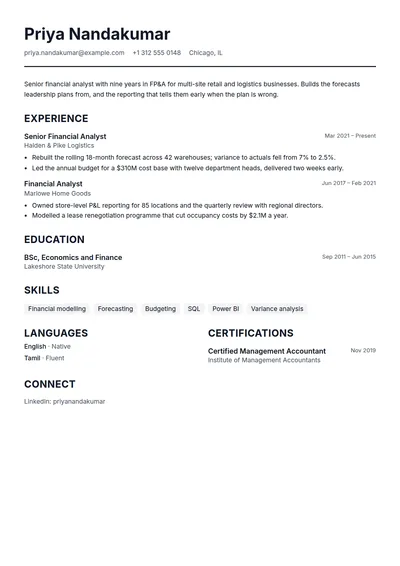
Start yours from this example

Opens this sample in the editor, in one of the templates below. Swap in your details, then tailor it to each vacancy in about two minutes.

Use this example

How an Australian CV differs

Graduate nursing in Australia runs on structured programs. Each state health system runs a recruitment round for transition to practice or graduate nurse programs, usually opening in the middle of the final year, where you rank health services and sometimes rotations and attach a CV, a cover letter or statement, and referees from placement. Private hospitals and aged care providers run their own programs on their own timelines. The CV goes to nurse educators and managers who read dozens in a week, so it must be easy to scan and honest about what a student has and has not done yet.

For a graduate registered nurse in Australia

  1. Placements are your experience

    List each clinical placement as an entry with the setting, the ward type, the facility and the hours. Put the final placement first and give it three or four bullets; earlier placements can be grouped in the education detail.

  2. AHPRA timing in plain words

    You cannot be registered before you finish, so write that your application is lodged or will be lodged on completion, and the month you expect to finish. Never write a registration number you do not yet have.

  3. Paid health work counts heavily

    Assistant in Nursing, personal care or Enrolled Nurse work during the degree shows you know shift work and wards. Give it its own entry with the ward and your duties, ahead of non-health jobs.

  4. Preferences match the CV

    If you rank a health service for its surgical rotation, make your surgical placement and interest visible on the CV you attach. A panel notices when the CV and the preferences point in different directions.

  5. Referees from placement

    Programs usually ask for a clinical referee, often a facilitator or preceptor from your final placement, and an employment referee. Ask them during the placement while they remember you.

  6. Checks and immunisations ready

    Placements already required a police check, a Working with Children Check and immunisation records. List them with the year so the health service can see you are ready to start in the new year.

Every CV in Australia

A4 paper
Australia prints on A4. A Letter-sized PDF prints short on A4 and tells a recruiter the CV came from a US template.
Two to three pages
Australian CVs run longer than UK ones: two pages is normal and three is accepted for experienced applicants. One page suits a first job.
No photo
No photo, date of birth or marital status. Australian employers do not expect them, and anti-discrimination law makes most prefer not to see them.
Dates as DD/MM/YYYY
Day first where a full date appears, month and year for each role. The US month-first order reads wrong to an Australian recruiter.
Australian English
Australian English follows British spelling: organise, programme, centre, licence, specialise.
Suburb and state, not a street address
"Parramatta, NSW" is enough on the contact line. A full address is not expected, and the US-style ZIP line never is.

More on applying in Australia, with every CV example for it, on the Australia page.

Templates for the graduate registered nurse CV

All templates

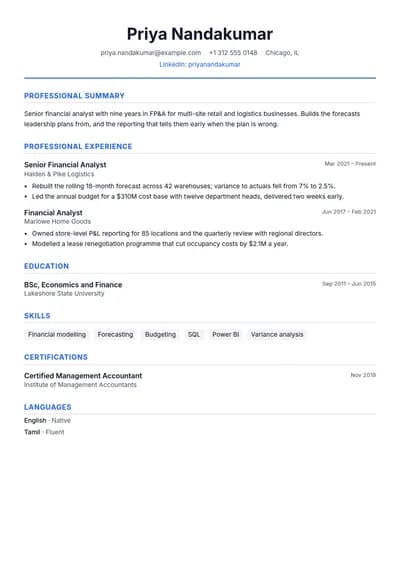
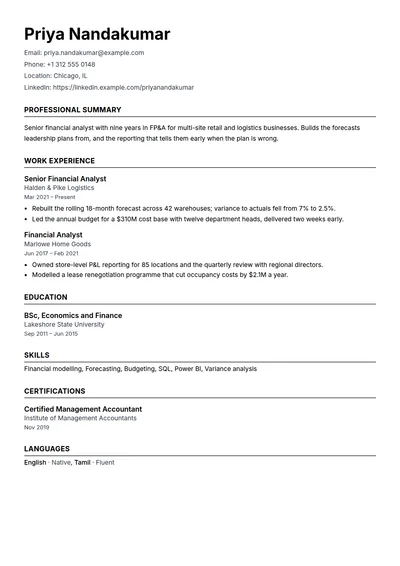
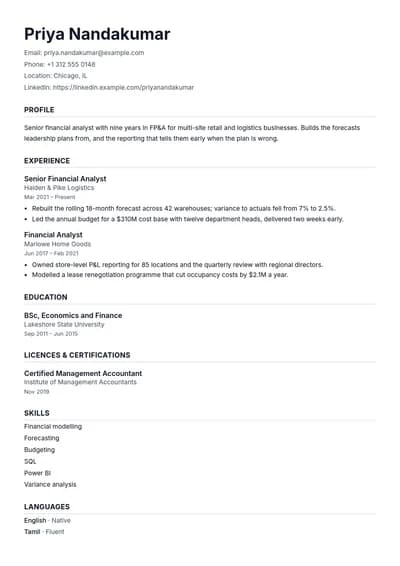
Every template exports on A4. The previews are drawn on Letter; the editor sets the page size when you export.

How the CV changes with experience

The same graduate registered nurse CV, written at three levels: a profile and three bullets for each.

Entry level

Zero to two years, or a first post in the title

Final-year nursing student with no paid health job, relying on 800 hours of placement and three years of part-time work in hospitality. Strong reflections from every placement and a clear interest in emergency nursing.

  • Completed a final placement in a regional emergency department, triaging alongside a preceptor and caring for patients in the short-stay unit.
  • Received a commendation from my mental health placement for building rapport with a young person on a long admission.
  • Worked as a shift supervisor at a café for three years, running a team of four on weekends while studying full time.

Mid level

Three to seven years, owns a process or a workload

Enrolled Nurse completing a Bachelor of Nursing pathway, with three years in Division 2 practice in aged care and two years of degree placements, now applying to a graduate program as a Registered Nurse.

  • Worked as an Enrolled Nurse in a 70-bed aged care home, administering medications and leading a team of personal care workers on afternoon shifts.
  • Gained credit for prior learning into the second year of the degree and completed acute placements in medicine and orthopaedics.
  • Applying for graduate programs that value existing medication and leadership experience in a regional health service.

Senior

Eight years or more, leads people, budgets or programmes

Career-changer graduating in nursing after twelve years as a paramedic, seeking a graduate program in a critical care or emergency stream.

  • Brought twelve years of pre-hospital assessment and emergency care to placements in intensive care and the emergency department.
  • Precepted student paramedics for five years, experience I use to support peers on placement.
  • Applying to graduate streams that offer an emergency or critical care rotation in the first year.

Skills to put on the graduate registered nurse CV

Hard skills

Clinical assessment
Graduate panels want to know you can complete a systematic assessment on your own and say what you found, because that is your first job on the ward.
Escalation of the deteriorating patient
Every state uses a track-and-trigger chart, and a placement story about escalating early is the strongest evidence a student can give.
Medication safety
You will give medications from your first supernumerary shift, so supervised competencies and the routes you have practised belong on the CV.
Documentation in an electronic record
Most health services run an eMR, and a graduate who has documented in one on placement needs less training time.
Patient education
Discharge teaching is something a graduate can own early, and panels like a concrete example with teach-back.

Soft skills

Reflective practice
Graduate interviews nearly always ask about a challenging placement moment, and a CV that shows you reflect sets up a good answer.
Asking for help
Nurse educators worry most about graduates who do not escalate, so showing that you check and ask is a strength, not a weakness.
Resilience
The first year of practice is demanding, and evidence that you managed study, work and placements together reassures a panel.

Mistakes that cost graduate registered nurse interviews

  1. Writing it like an experienced nurse's CV

    Inventing a patient load or a classification you do not have reads as overreach. Be precise about what you did under supervision; that honesty is what a graduate panel trusts.

  2. Placements without hours or settings

    A line that just says 'placements completed' tells the panel nothing. Name each setting, the ward type and the hours, so they can see the breadth of your training.

  3. Leaving out your AIN or care job

    Students sometimes drop paid care work because it is not nursing. It is the strongest evidence you can handle a shift, so give it a full entry with bullets.

  4. One CV for every program

    A rural health service, a metropolitan tertiary hospital and a mental health program look for different things. Adjust the summary and the order of placements for each preference.

  5. Missing the recruitment deadline details

    Graduate rounds have fixed closing dates and attachments. A CV saved under a clear file name, with the right referees and checks listed, avoids a rejected application.

Write bullets with the XYZ formula: what changed, the number that shows it, and how you did it, in one line.

Questions about the graduate registered nurse CV

What should a graduate nurse CV include in Australia?

Your degree and expected completion date, your AHPRA application status, each clinical placement with setting and hours, any paid health work, your skills and competencies, your checks and immunisations, and two referees, one of them clinical.

How long should a graduate nurse CV be?

Two pages of A4 at most. Put the headline, summary, final placement and paid health work on page one, and the rest of the placements, checks and referees on page two.

When do graduate nurse programs open?

State health rounds usually open in the middle of the final year for a start in the following year, and some have a second, smaller intake. Private hospitals and aged care providers recruit on their own schedules, so check each one.

Should I list my placements as experience or education?

Give the final placement its own entry so it is read as experience, and list the others in the degree's detail line. That way the panel sees your most recent, most independent work first.

How is a graduate CV different from an experienced Registered Nurse CV?

An experienced nurse leads with a ward, a classification and a patient load. A graduate leads with training, placements and potential, and is assessed for a supported program rather than a single vacancy.

Can I tailor one CV to several graduate preferences?

Keep one master CV and adjust the summary and the order of placements for each health service you rank. Resume Master can rewrite the summary and bullets against each program's description so each version stays focused.

Every application goes out fitting the vacancy.

Paste a vacancy, get a CV rewritten for it in about two minutes.

Tailor your CV — free

Free to start. No card. Same price on web, iOS and Android.