Inventory Manager Resume Example

An inventory manager resume is read for three numbers: how accurate your counts were, how much stock you carried against demand, and how much shrink or write-off you prevented. Give the value and the number of SKUs you controlled, the systems you ran them in and the accuracy, turns and fill-rate results, and a distribution or operations manager will know within seconds whether you fit.

The Sample resume below belongs to an inventory manager with six years in building-materials distribution and a wholesale distribution center, responsible for stock worth up to $22M across two sites. The bullets show cycle-count accuracy rising, excess stock falling, stockouts shrinking and a WMS implementation landing, each with the method behind it, such as ABC classification, cycle counting or reorder-point changes.

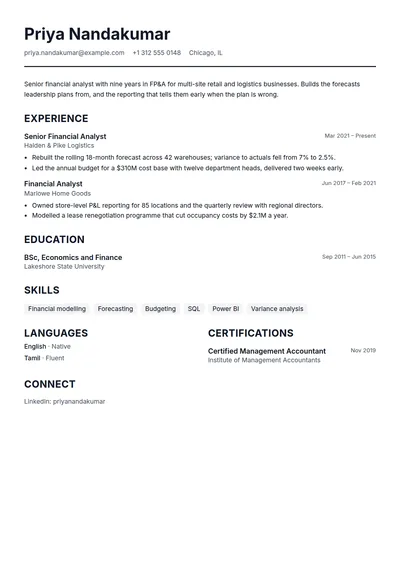
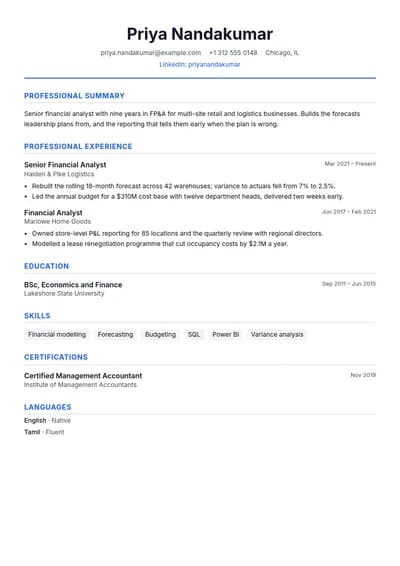
Fit the page to the posting. Retail inventory wants shrink control, replenishment and store-level accuracy; distribution wants WMS discipline, slotting and dock-to-stock time; manufacturing wants raw material planning, MRP and work-in-process control. The analysis side of the same work is in the supply chain analyst example, and the supply chain manager example shows the next step up. The Professional template suits the classic operations resume this title expects.

Updated . The person and employers in this Sample resume are fictional.

Want a blank version to fill in? The inventory manager resume template is a free Word and Google Docs file.

Applying outside the US? This title as a CV for the UK.

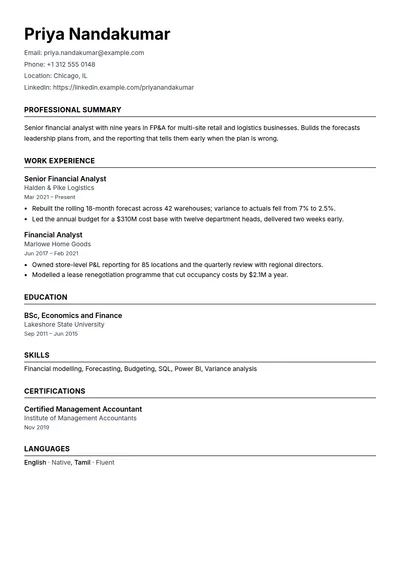
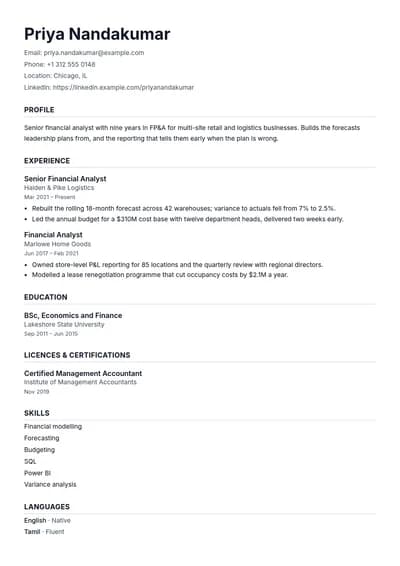
Inventory Manager sample resume

Rachel Oduya

Inventory Manager, Distribution and Wholesale

Kansas City, MO[email protected](816) 555-0121

Summary

Inventory manager with six years controlling stock worth up to $22M across two distribution sites and 18,000 active SKUs. Raised cycle-count accuracy from 94 to 99.3 percent and reduced excess and obsolete inventory by $1.4M in two years while keeping the fill rate above the company target. Leads a team of eight counters and inventory clerks, and has run a full WMS migration without a shutdown or a physical inventory writedown.

Experience

Inventory Manager, Stonegate Building Supply

– Present

Kansas City, MO

  • Control $22M of lumber, roofing, hardware and millwork inventory across a main distribution center and a branch yard, with 18,000 active SKUs and a team of eight.
  • Raised cycle-count accuracy from 94 to 99.3 percent by moving to daily ABC-based counts, fixing the top twelve variance root causes and holding weekly reviews with receiving.
  • Reduced excess and obsolete stock by $1.4M over two years through a monthly slow-mover review, vendor returns and a markdown program with sales.
  • Led the site's migration to a new warehouse management system, retraining 40 warehouse staff and completing go-live with no shipping interruption and a variance under 0.2 percent at the post-conversion count.
Inventory Control Supervisor, Northfield Distribution Partners

–

Lenexa, KS

  • Supervised four inventory clerks in a 220,000-square-foot wholesale distribution center carrying about 9,000 SKUs of janitorial and packaging supplies.
  • Cut stockouts on the top 500 SKUs by 40 percent by rebuilding reorder points and safety stock from twelve months of demand data instead of the vendor's defaults.
  • Brought dock-to-stock time from 30 hours to under 12 by re-sequencing receiving checks and adding a put-away priority for backordered items.
  • Ran the annual physical inventory two years running with shrink under 0.3 percent of inventory value, the lowest the site had recorded.

Education

Associate of Applied Science in Supply Chain Management

Prairie Bend Community College, Independence, MO

Skills

  • Cycle counting and ABC classification
  • Warehouse management systems (WMS)
  • ERP inventory modules (SAP MM, NetSuite)
  • Reorder points, safety stock and min-max planning
  • Excess and obsolete inventory reduction
  • Shrink control and loss prevention
  • Physical inventory planning
  • Slotting and put-away optimization
  • Receiving and dock-to-stock processes
  • Vendor returns and RMA processing
  • Excel (pivot tables, lookups) and Power BI
  • Team leadership and shift scheduling
  • Forklift and RF scanner operation

Certifications

  • Certified in Planning and Inventory Management (CPIM), Association for Supply Chain Management (ASCM),
Start yours from this example

Opens this sample in the editor, in one of the templates below. Swap in your details, then tailor it to each posting in about two minutes.

Use this example

Already have an inventory manager resume? Check it against a posting

Paste your resume and the posting you want. The keyword match, the terms you are missing and the biggest fix show here as you type, in your browser. Nothing is sent until you ask for the version written for that posting.

Check your fit — free, no account

Worked out in your browser as you type. Nothing is sent.

Result

A staff nurse's resume against a charge nurse posting. Paste yours to see your own.

33%

13 of the posting's 40 terms are on this resume.

Missing
  • coordinate
  • shift
  • staffing

Biggest fix: 2 bullets open with a duty, not a result.

A keyword match, not a verdict from any applicant tracking system.

Templates for the inventory manager resume

All templates

How to write an inventory manager resume

  1. Describe the operation in the headline

    Inventory jobs differ more by setting than by title, so tell the reader which setting you run: Inventory Manager, Wholesale Distribution, 18,000 SKUs, Manhattan WMS or Inventory Control Manager, Food Manufacturing, Raw Materials and WIP. An operations director scanning applicants can then tell at once whether you know their kind of stock, whether that is perishable, serialized, bulky or high-value. If your employer called the role "Materials Manager" or "Stock Control Lead," keep the real title on the job line and use the headline to match the posting's wording for the same work.

  2. Summarize with value, accuracy and one working-capital result

    Three sentences: the dollar value and SKU count you control and across how many sites, the accuracy you hold with the starting point it came from, and one result that freed cash or cut loss, such as excess stock cleared or shrink reduced. Add the size of the team you lead. Finance reads inventory as money tied up, so a summary that mentions turns or dollars released speaks to the person who approves the hire as well as to the warehouse manager who interviews you. Skip phrases like "detail-oriented inventory professional" that every applicant uses.

  3. Write bullets as before, after and method

    Every strong inventory bullet has three parts: the measure before, the measure after, and the method that moved it. Raised location accuracy from 92 to 99 percent in nine months by moving from an annual count to daily ABC cycle counts and tracing every variance over $500 to its cause. Use the measures your industry tracks: inventory record accuracy, turns or days on hand, fill rate, stockouts on key items, shrink, excess and obsolete value, dock-to-stock time. If you do not have the before figure, give the period and the scale instead; never invent a baseline an interviewer could ask you to explain.

  4. Show the control process you own

    Hiring managers want to know that accuracy will survive when you are on vacation, so describe the process, not just the result. Who approves adjustments and above what value, how often counts run and on which items, how variances are researched, what reports go to finance each month, and how receiving and shipping errors are fed back to the teams that make them. Mention audit work too: annual physical inventories, external auditor test counts and any controls you wrote. Under the systems line, name the WMS or ERP you ran (SAP, Oracle, NetSuite, Manhattan, Blue Yonder, Fishbowl) and the reports or dashboards you built in Excel or Power BI.

  5. List certifications and the training that fits the setting

    ASCM's CPIM and CSCP are the certifications most often named in inventory and supply chain postings; list one with the year earned, or "CPIM in progress, Part 1 passed" if you are partway. A Lean or Six Sigma belt helps when the posting talks about process improvement. Degrees in supply chain, logistics, business or operations go in one line. Manufacturing roles may also ask for MRP or production planning experience, and food or pharmaceutical roles for lot tracking and FIFO or FEFO rotation, so name those where you have them. The supply chain manager example shows how the planning side presents these credentials.

  6. Separate inventory control work from inventory management

    Postings for inventory control specialists and inventory control supervisors read for counting accuracy, research of discrepancies, receiving checks and system transactions. Postings for inventory managers add policy and money: setting reorder points and safety stock, deciding what to write off, budgeting for shrink and leading the team. If you are moving up from control to management, put the decisions you already made at the top of each job, such as changing a reorder point, recommending a write-off or training new counters, so the reader sees management judgment rather than only a high count rate. The operations manager example covers the step beyond inventory.

Inventory Manager resume summary examples

Three sentences at the top of the page, written for where you are now.

Inventory control specialist stepping up to manager

Inventory control specialist with four years in a third-party logistics warehouse serving three retail clients, holding location accuracy above 99 percent across 7,500 SKUs. Research and resolve every variance over $250, train new cycle counters and recommended the reorder point changes that ended repeated stockouts on two clients' top items. Ready to own inventory policy and lead a counting team.

Retail inventory and shrink

Retail inventory manager with seven years across big-box stores and a regional distribution center, responsible for replenishment and shrink for 42 stores. Brought annual shrink down for three years running through receiving audits, high-theft item controls and store-level count training. Work closely with loss prevention and merchandising on what to stock and where.

Manufacturing materials and WIP

Materials and inventory manager with nine years in food manufacturing, controlling $14M of raw materials, packaging and finished goods with full lot traceability. Set MRP parameters and safety stock for 2,300 components and kept production lines running through two supplier shortages. Lead a team of six and run the monthly inventory reconciliation with plant finance.

Military supply veteran moving into civilian inventory

Former Army supply sergeant with eight years accounting for equipment and supplies worth $30M across a battalion, with no unresolved losses in four command inspections. Ran hand-receipt reconciliations, cyclic inventories and property book transactions, and trained 20 unit supply clerks. Looking to bring the same accountability to a distribution or manufacturing inventory team.

How the resume changes with experience

The same inventory manager resume, written at three levels: a summary and three bullets for each.

Entry level

Zero to two years, or a first role in the title

Inventory clerk with two years of cycle counting, receiving and RF scanning in a distribution center, plus an associate degree in supply chain management. Accurate, systematic and comfortable with WMS and Excel.

  • Count 300 to 400 locations a day by RF scanner with a personal accuracy above 99 percent.
  • Found a recurring receiving error that had inflated one SKU's on-hand count for months, and the fix stopped repeated stockouts.
  • Chose to recount an entire aisle instead of adjusting one location after noticing a pattern, catching six more variances.

Mid level

Three to seven years, owns a process or a workload

Inventory manager with five years controlling multi-million-dollar stock in distribution, leading count teams and owning accuracy, turns and shrink targets.

  • Control $12M of inventory across 11,000 SKUs with a team of five.
  • Raised inventory turns from 5.1 to 6.4 in eighteen months by tightening reorder points and clearing slow movers.
  • Delayed a planned slotting change when the data showed it would slow the busiest pick zone during peak season.

Senior

Eight years or more, leads people, budgets or programs

Senior inventory and materials manager with twelve years across distribution and manufacturing, owning network-wide inventory policy, systems and a team of supervisors.

  • Own inventory policy for four distribution centers holding $90M in stock with a staff of 30.
  • Reduced network inventory by $11M in two years while lifting fill rate to the highest level in company history.
  • Overruled a proposal to centralize slow movers in one site after modeling the service-level loss for the two farthest regions.

More inventory manager resume bullet points

Pick the ones that are true for you, then put your own numbers in.

Accuracy and counts

  • Replaced the annual wall-to-wall count with a daily ABC cycle count, holding record accuracy above 99 percent for two straight years.
  • Traced a run of negative on-hand balances to a unit-of-measure mismatch between purchasing and receiving, and fixed it in the item master.
  • Ran three year-end physical inventories with external auditors and closed each with no adjustment requested.
  • Cut unresolved variances older than 30 days from 180 locations to fewer than 10 with a daily research queue.

Stock levels and working capital

  • Raised inventory turns from 4.8 to 6.1 in a year by resetting reorder points on the 2,000 fastest-moving SKUs.
  • Cleared $900K of slow-moving stock through vendor returns, transfers to sister branches and planned markdowns.
  • Lifted fill rate on A items from 93 to 98 percent while total inventory value fell by $1.1M.
  • Built a weekly exception report in Power BI that flagged items with no sales in 90 days before they turned obsolete.

Process, systems and people

  • Wrote the adjustment approval policy, requiring manager sign-off above $1,000, which finance adopted for every site.
  • Tested and signed off the inventory module of a new ERP system before go-live, catching 40 item records with wrong units of measure.
  • Trained 25 receivers and pickers on RF scanning standards, and mis-picks fell by more than half in a quarter.
  • Promoted two counters to inventory analyst roles after coaching them on variance research and Excel reporting.

Skills to put on the inventory manager resume

Hard skills

Cycle counting and accuracy programs
Accuracy is the first metric every hiring manager asks about, and a program you built with the numbers to show for it settles the question.
WMS and ERP systems
Postings name their system, and running the same one, or having migrated between two, shortens onboarding and shows you understand the data behind the shelves.
Demand-based replenishment
Reorder points and safety stock built from real demand cut both stockouts and excess, the two problems inventory managers are hired to fix.
Excess and obsolete management
Dead stock ties up cash, and finance leaders notice an inventory manager who returns it to the balance sheet.
Shrink and loss control
Retail and distribution employers measure shrink to the tenth of a percent, and a low figure is a strong headline.
Physical inventory and audit support
Year-end counts and auditor sampling are unavoidable, and a clean history shows your records can be trusted.
Data analysis in Excel or Power BI
Variance root causes, slow-mover lists and turns calculations all start in a spreadsheet, and interviews often include a data question.
Receiving and put-away process design
Most accuracy problems start at the dock, and managers who have fixed receiving flows prove they understand the whole chain.

Soft skills

Attention to detail
A single transposed digit becomes a stockout or a write-off, and managers want someone who notices before the count does.
Leadership of hourly teams
Counters and clerks work early and late shifts, and keeping them accurate and motivated is management, not clerical work.
Cross-department coordination
Purchasing, sales, receiving and finance all touch inventory, and you have to get each of them to change habits.
Calm during peak and audits
Physical inventories and system cutovers are stressful, and steady leadership through them is what earns promotions.

Keywords from inventory manager job postings

Use the ones you can back up with a bullet. Paste the posting into the free resume keyword checker to see which of its terms your resume is missing.

  • inventory control
  • inventory management
  • cycle counting
  • inventory accuracy
  • ABC analysis
  • physical inventory
  • shrink reduction
  • excess and obsolete inventory
  • inventory turns
  • fill rate
  • replenishment
  • reorder points
  • safety stock
  • demand planning
  • WMS
  • ERP
  • SAP
  • RF scanning
  • receiving and put-away
  • variance reconciliation
  • root cause analysis
  • lot traceability
  • KPI reporting
  • Excel
  • team leadership

Mistakes that cost inventory manager interviews

  1. No dollar value or SKU count

    The scale of inventory you controlled is the first thing a reader wants to know. State the value, the number of SKUs and the number of sites in your summary and in each job.

  2. Accuracy claimed without a starting point

    Improved accuracy is not a result. Give the before and after figures and what you changed to get there, such as moving from quarterly counts to daily ABC cycle counts.

  3. Systems listed, never used

    Instead of a bare list of WMS and ERP names, say what you did in them: configured cycle-count schedules, ran variance reports, led a migration or trained users.

  4. Treating shrink as somebody else's problem

    If shrink, damage or write-offs fell on your watch, claim it with the number and the controls you introduced. Employers in retail and distribution read for it.

  5. Ignoring the people you led

    Inventory managers run teams of counters and clerks. Give the headcount, the shifts and how you trained or scheduled them, because the job is leadership as much as data.

Write bullets with the XYZ formula: what changed, the number that shows it, and how you did it, in one line.

Questions about the inventory manager resume

What metrics belong on an inventory manager resume?

Inventory accuracy, inventory turns, fill rate or stockout rate, shrink, excess and obsolete dollars, dock-to-stock time and days of inventory on hand. Use the two or three you actually moved in each job.

Is a CPIM or CSCP certification worth it?

Yes for distribution and manufacturing roles, where ASCM credentials are recognized and sometimes preferred. List the credential in your headline once you have it.

How do I show WMS experience if I did not run an implementation?

Describe the daily work: cycle-count schedules you managed, variance reports you built, slotting changes you configured or user training you delivered. Depth of use matters more than a cutover.

Can a retail inventory background move into distribution?

Yes. Lead with accuracy, shrink and replenishment results, which translate directly, and add any experience with receiving, backroom organization or a stock-management system.

How long should an inventory manager resume be?

One page for most managers, two for those who have run multiple sites or major system projects. Keep every bullet tied to accuracy, availability, cost or people.

Every application goes out fitting the job.

Paste a posting, get a resume written for it in two minutes.

Tailor your resume — free

Free to start. No card. Same price on web, iOS and Android.