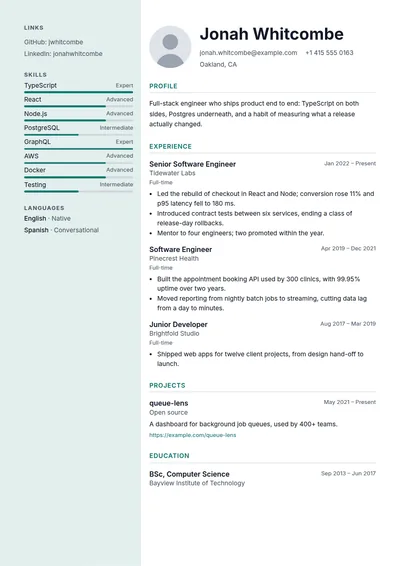
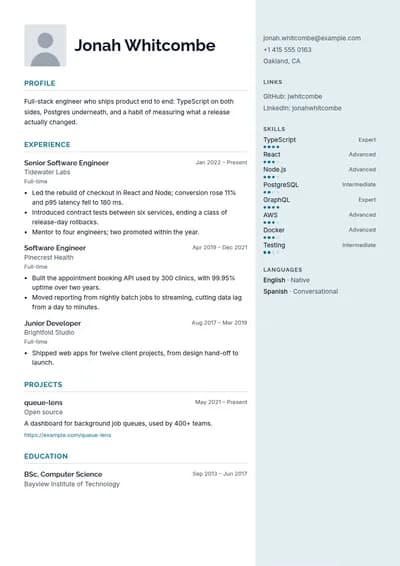
Supply Chain Analyst Resume Example

Supply chain analysts are hired for what their analysis changed: a freight bill that fell, a forecast that got more accurate, a supplier that started delivering on time. The resume should show the data you worked with, the tools you used to model it and the decision a manager made because of your work, with the dollar or service-level effect attached.

The Sample resume below belongs to a supply chain analyst with six years in consumer packaged goods and freight, moving from carrier and route analysis into demand planning and network modeling. The bullets pair each analysis with an outcome: a carrier bid that lowered cost per shipment, a forecast model that cut error, a safety stock rebuild that reduced both inventory and stockouts. SQL, Excel and Power BI appear in the context of the questions they answered.

Read the posting for its slant. Demand planning roles want forecast accuracy and S&OP experience; logistics analyst roles want freight rates, carrier performance and routing; procurement analyst roles want spend analysis and supplier scorecards. For the hands-on stock side see the inventory manager example, and the data analyst example shows how a more general analytics page is written. The Stack template gives tools and metrics a clear column of their own.

Updated . The person and employers in this Sample resume are fictional.

Supply Chain Analyst sample resume

Kevin Nakashima

Supply Chain Analyst, Demand Planning and Logistics

Nashville, TNkevin.nakashima@example.com(615) 555-0167

Summary

Supply chain analyst with six years in consumer goods and freight, turning shipment, demand and supplier data into decisions that lowered cost and protected service. Built the demand forecast model a $300M snack and beverage business now plans on, cutting forecast error by nine points and freeing $2.1M of safety stock without a fill-rate loss. Works in SQL, Excel and Power BI daily and presents the monthly S&OP numbers to the operations and finance leads.

Experience

Supply Chain Analyst, Aldermere Consumer Brands

– Present

Nashville, TN

  • Own the demand forecast and inventory analytics for 420 finished-goods SKUs across three plants and four distribution centers, and present the numbers at the monthly S&OP meeting.
  • Rebuilt the statistical forecast in a mix of seasonal and promotional models, lowering weighted forecast error from 31 to 22 percent over one planning year.
  • Recalculated safety stock by SKU and location from service-level targets and demand variability, releasing $2.1M of inventory while the fill rate held at 98.6 percent.
  • Built a Power BI supplier scorecard from ERP receipt data that the procurement team now uses in quarterly reviews; on-time delivery from the ten largest suppliers rose from 84 to 93 percent.
Logistics Analyst, Pinehurst Freight Solutions

–

Memphis, TN

  • Analyzed roughly 60,000 truckload and LTL shipments a year for a third-party logistics provider's retail and food clients, reporting cost per mile, on-time performance and claims.
  • Ran the annual carrier bid for a client's 38 lanes in Excel and the transportation management system, lowering average cost per shipment by 11 percent with no drop in on-time delivery.
  • Identified a consolidation opportunity in two clients' LTL shipments to the same region, and the resulting multi-stop truckload program saved about $340,000 a year.
  • Automated the weekly carrier performance report in SQL and Power BI, replacing six hours of manual spreadsheet work with a refreshable dashboard.

Education

Bachelor of Business Administration in Supply Chain Management

Ridgeline State University, Chattanooga, TN

Skills

  • Demand forecasting and statistical modeling
  • S&OP process support
  • Safety stock and inventory optimization
  • SQL (queries, joins, window functions)
  • Excel (Power Query, Solver, pivot tables)
  • Power BI and Tableau
  • Transportation management systems (TMS)
  • ERP data (SAP, Oracle) extraction
  • Carrier bids and freight rate analysis
  • Supplier scorecards and spend analysis
  • Network and lane analysis
  • Python (pandas) for data cleaning
  • Presenting to operations and finance leaders

Certifications

  • Certified Supply Chain Professional (CSCP), Association for Supply Chain Management (ASCM),

Start yours from this example

Bring your own resume or start blank, then tailor it to each posting in about two minutes.

Use this example

Templates for the supply chain analyst resume

All templates

How the resume changes with experience

The same supply chain analyst resume, written at three levels: a summary and three bullets for each.

Entry level

Zero to two years, or a first role in the title

Supply chain graduate with a planning internship and strong Excel and SQL skills, ready to own reports, clean data and support planners with analysis they can act on.

  • Maintained the weekly inventory and backorder report for 1,200 SKUs during a planning internship.
  • Found a unit-of-measure error in supplier data that had overstated on-hand stock on 40 items, and purchasing corrected the orders.
  • Recommended a manual review step for new-product forecasts after seeing the statistical model overfit to launch data.

Mid level

Three to seven years, owns a process or a workload

Supply chain analyst with four years in distribution, owning demand planning analytics, freight reporting and the models behind monthly planning decisions.

  • Own forecasting and inventory analytics for 300 SKUs across two distribution centers.
  • Cut expedited freight spend by a quarter in one year by exposing the SKUs and suppliers driving it.
  • Advised against a supplier switch that looked cheaper on unit price after modeling the landed cost with longer lead times.

Senior

Eight years or more, leads people, budgets or programs

Senior supply chain analyst with nine years in consumer goods, leading analytics for planning and logistics, mentoring analysts and owning the network models behind capital decisions.

  • Lead a team of three analysts supporting planning, procurement and logistics for a $900M business.
  • Network redesign analysis moved a distribution center and cut outbound freight cost by $4.6M a year.
  • Rejected the first version of a vendor's optimization output after finding it ignored a customer delivery-window constraint, and the corrected model changed the recommendation.

Skills to put on the supply chain analyst resume

Hard skills

Forecasting and demand planning
Forecast error is the number planning leaders answer for, and analysts who have reduced it get hired for planning roles.
Inventory optimization
Safety stock and reorder policies set from data free cash without hurting service, a result finance and operations both notice.
SQL and data extraction
Supply chain data lives in ERP and WMS tables, and analysts who can query it directly do not wait for IT.
Excel modeling
Bids, scenarios and what-if analyses still run in spreadsheets, and interviewers often test your Excel on the spot.
Dashboards (Power BI or Tableau)
A report that leaders open weekly is proof your analysis changes behavior, not just decks.
Freight and carrier analysis
Transportation is often the largest controllable cost, and a bid or consolidation with a savings figure is a strong bullet.
S&OP and planning processes
Analysts who understand how the monthly planning cycle works can support it from day one.
Supplier and spend analysis
Procurement teams hire analysts who can build a scorecard and find the savings hiding in the spend data.

Soft skills

Translating data into decisions
Managers do not want a spreadsheet; they want the recommendation and the risk, and interviews test whether you can give it.
Skepticism about data quality
Bad master data produces confident wrong answers, and analysts who check sources first save companies money.
Working across functions
Planning sits between sales, operations and finance, and you will need each to trust your numbers.
Prioritizing requests
Everyone wants a report, and choosing the analysis that moves cost or service is a judgment managers value.

Mistakes that cost supply chain analyst interviews

  1. Analysis without a decision

    Built a dashboard or analyzed freight data is only half a bullet. Say what changed because of it: the carrier awarded, the safety stock released, the supplier put on a corrective plan.

  2. Tools as achievements

    Knowing SQL and Power BI gets you through the screen, not the interview. Name the tools in your skills, and use the bullets for the questions you answered with them.

  3. No scale

    Say how many SKUs, shipments, lanes, suppliers or dollars your analysis covered. A forecast for 40 items and one for 4,000 are different jobs.

  4. Forecast accuracy stated without the measure

    Give the metric you used, such as weighted MAPE or bias, the level it was measured at and the before-and-after figures. Planning leaders will ask.

  5. Skipping the presentation side

    If you present at S&OP, carrier reviews or supplier meetings, say so. Analysts who can stand in front of operations leaders are promoted faster.

Questions about the supply chain analyst resume

What is the difference between a supply chain analyst and a logistics analyst?

Logistics analysts focus on transportation and warehousing data, such as freight cost and carrier performance. Supply chain analysts cover a wider span that may include demand planning, inventory and procurement. Use the posting's title and let your bullets show the range.

Which certifications help a supply chain analyst?

ASCM's CSCP and CPIM are the most recognized. Tool certifications for Power BI or Tableau help for analytics-heavy roles, and a Six Sigma Green Belt suits process-oriented teams.

Should I include Python or R?

Yes if you have used them on real work, such as cleaning shipment data or building a forecast. Give a concrete example rather than listing the language alone.

How do I show results when the savings were a team effort?

Describe your part precisely: built the model, ran the bid analysis, identified the consolidation. Then give the team's result and make clear you are reporting the project's outcome, not claiming it alone.

How long should a supply chain analyst resume be?

One page through about seven years of experience. A second page is justified only for senior analysts leading teams or major network projects.

Every application goes out fitting the job.

Paste a posting, get a resume rewritten for it in two minutes.

Tailor your resume — free

Free to start. No card. Same price on web, iOS and Android.